

Classic Horror Behind the Scenes: What ABBOTT AND COSTELLO MEET FRANKENSTEIN Meant to Bela Lugosi
The proud star of DRACULA (1931) had high hopes for a revived film career when he stepped in front of the cameras in 1948. Sadly, in spite of his marvelous performance, it was not to be.

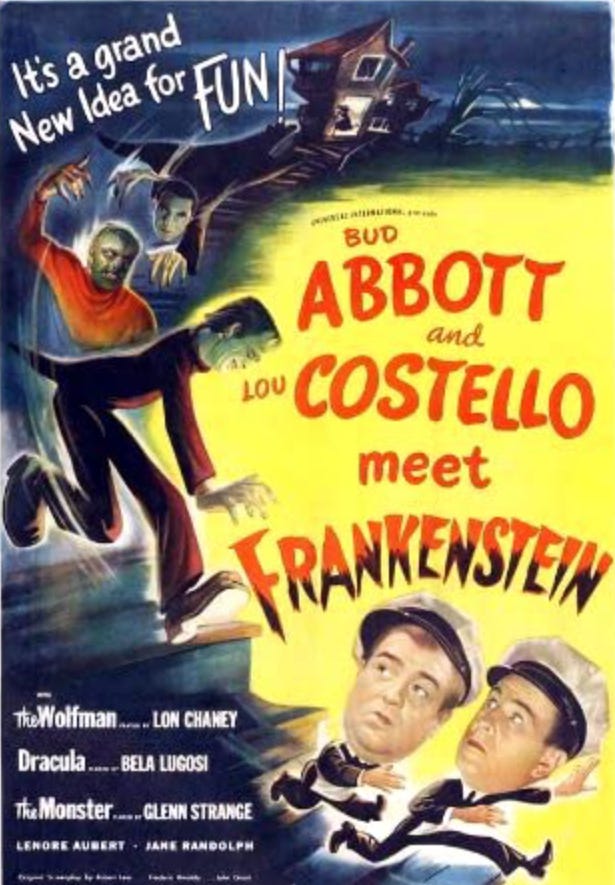
By Bill Fleck, author of the Rondo Hatton Classic Horror Awards-nominated book Chaney’s Baby, available here.
Saturday, February 14, 1948. Bela Lugosi, 65, is on set at Universal-International as Dracula.
For Dracula, The Wolfman, and the Frankenstein monster are about to take their chances by going up against the legendary slapstick antics of Abbott and Costello…both on and off screen.
Lugosi’s graying hair is blackened, his lips are fiercly painted, and his face is thickly caked with powder. He’s just postponed a London stage revival of Dracula to be here because the $8000 he’ll be paid by the studio—worth a little more than $93,000 when adjusted for inflation at this writing—is much better money.
And—as usual—he desperately needs money.
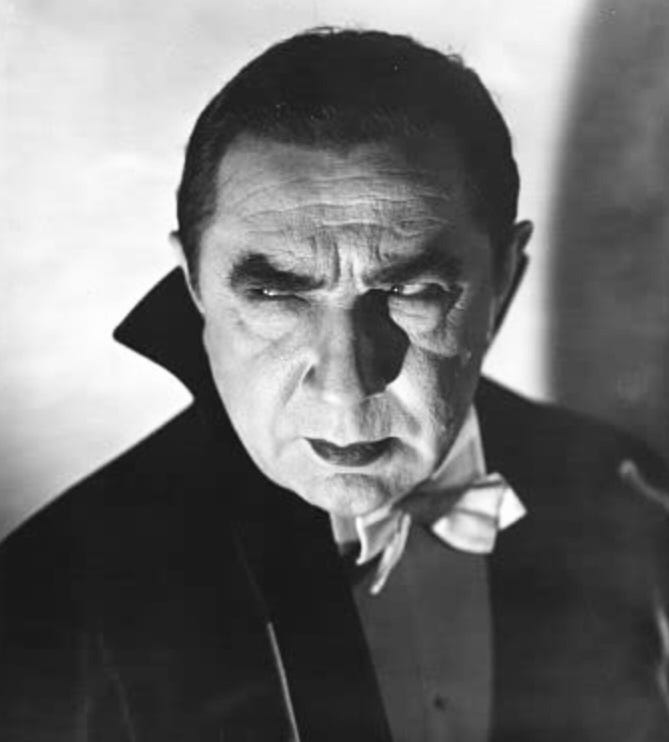
[Above: Makeup artist Bud Westmore, possibly thinking Lugosi was too old to play Dracula, made him up heavily.]
Then, too, I wonder…has it occurred to Lugosi that early February is certainly an interesting time for him to begin reprising his most famous screen role? After all, it was near to this very day—February 12, 1931, seventeen years and two days in the past—that the film version of Dracula, featuring Lugosi in a star-making performance, was unleashed on the public. [1]
For the proud actor, it’s been a roller coaster ride on a whirling dervish ever since.
Does he think about any of that ride as he puffs on his beloved, ever-present cigar in the few quiet moments he gets before the typical chaos erupts on the Abbott and Costello set?
October 20, 1882. Béla Ferenc Dezsö Blasko is born in Lugos, Hungary. [2] He’s the fourth child of Istvan and Paula Blasko. Béla comes from a line of farmers, but Istvan has shaken off that occupation to become a baker. Shortly after Béla’s birth, Istvan gets a prestigious job in banking.
Istvan’s obvious ambition is well-represented in his youngest child. Béla, too, is bright and ambitious…and none too fond of being told what to do. At the age of 12, he drops out of school and hoofs it to Resita, a little less than 35 miles from home. There, he finds intermittent work as a miner and a machinist.
But his dream is to become an actor. He hooks up with a theater troupe in Resita, and before long, he’s happily performing all over Hungary. Eventually, he changes his name to Bela Lugosi in honor of his home.
Much to Lugosi’s delight, the troupe encourages the young actor to experiment, to try a wide variety of parts. Sadly, if you look up the word typecast today, Lugosi’s picture should be there. But such is not the case when he gets started…which is no doubt why being typecast later in Hollywood gets him so boiling mad.
Future typecasting or no, Lugosi’s ambitions are put on hold when the Great War violently breaks out. The nearly 32-year-old actor leaves Hungary’s National Theater to become a second lieutenant in the ski patrol. He’s later seriously wounded in battle.
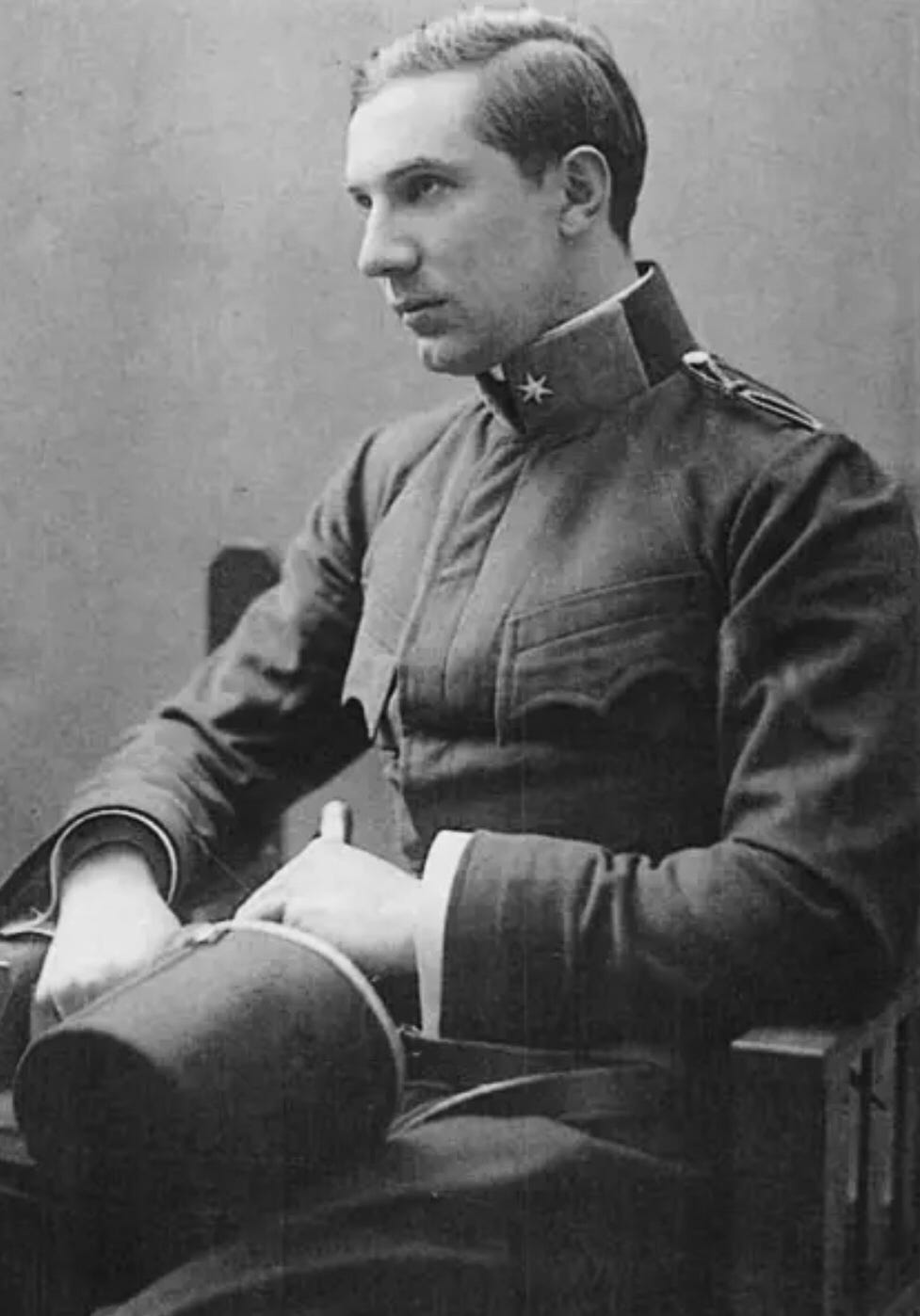
[Above: Lugosi’s acting career was interrupted by the Great War. Lugosi served and was wounded. The pain from those wounds would come back to haunt him in later years.]
In 1916, the-by-now Captain Lugosi is discharged and gets back to acting. Handsome and magnetic, he scores a variety of romantic roles—some in films under the name Arisztid Olt. He also scores his first wife. [3]
But political turmoil ensnares Lugosi when he openly endorses the communist regime of Bela Kuhn. Once Kuhn is forced out by Miklos Horthy shortly after, Lugosi finds himself with a target on his back. A quick dash to Vienna, Austria leaves him without a country…and without a wife.
Crossing into Germany, the actor finds work in films. But the lure of America is strong, and a year later, Lugosi—without a passport—talks his way into a job on the Graf Tisza Istvan, an Italian freight ship.
December 5, 1920. The Graf Tisza Istvan docks in New Orleans. Lugosi reports promptly to U.S. authorities. The charming, 38-year-old actor is alone, broke, and doesn’t speak English. But he’s nothing if not confident.
By early the following year, he’s thriving in the Hungarian theater community in New York City. He’s put together his own company and—like a prototype Orson Welles—is producing, directing, and starring in a variety of plays.
December 20, 1922. Lugosi makes his Broadway debut in The Red Poppy. Still struggling with English, the actor has amazingly learned his part phonetically. He gets rave reviews, but the play doesn’t—it closes shortly thereafter.
Still, an influential exec at Fox Studios has seen it, and is more than impressed with Lugosi. He casts the tall, mysterious actor in The Silent Command (1923). Bela continues to tread the boards as well—The Devil Is in the Cheese and Arabesque among others.
But the big one will come in 1927.
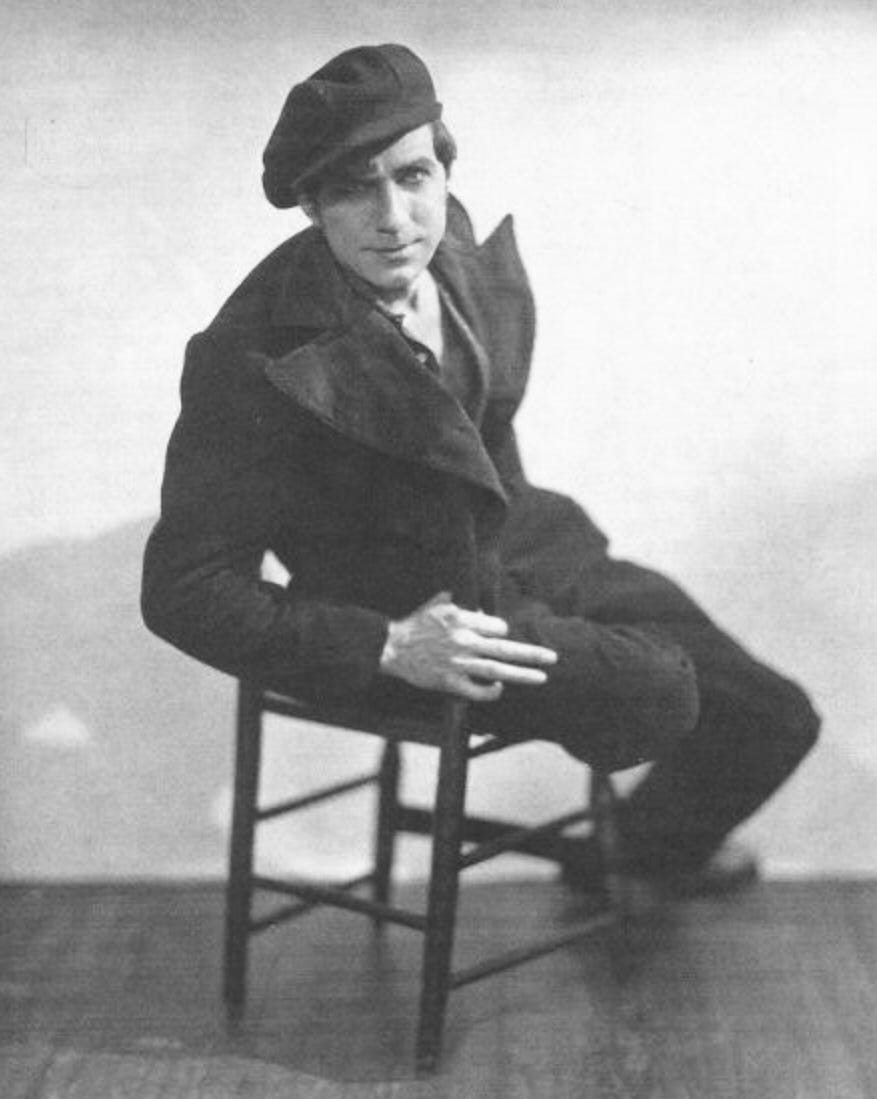
[Above: Lugosi in THE RED POPPY on Broadway. A Fox executive takes notice of him and puts him in American films.]
The novel Dracula by Bram Stoker was released in 1897. It sold reasonably well, but didn’t make Stoker rich. By 1923, Florence Stoker—Bram’s widow—is broke enough to offer the stage rights to actor and playwright Hamilton Deane. [4] Deane alters much of the action in the novel, and cleans up the character of Dracula, making him appear to be more acceptable in polite society.
Deane stages Dracula in England. Publisher Horace Liveright sees potential, and purchases the rights for the United States. Director John D. Williams, who has seen Lugosi in The Devil in the Cheese, convinces Liveright to hire Bela as Dracula. [5]
October 25, 1927. Dracula opens. It runs for thirty-three colossal weeks on Broadway before going on tour. Lugosi is a phenomenon as well.
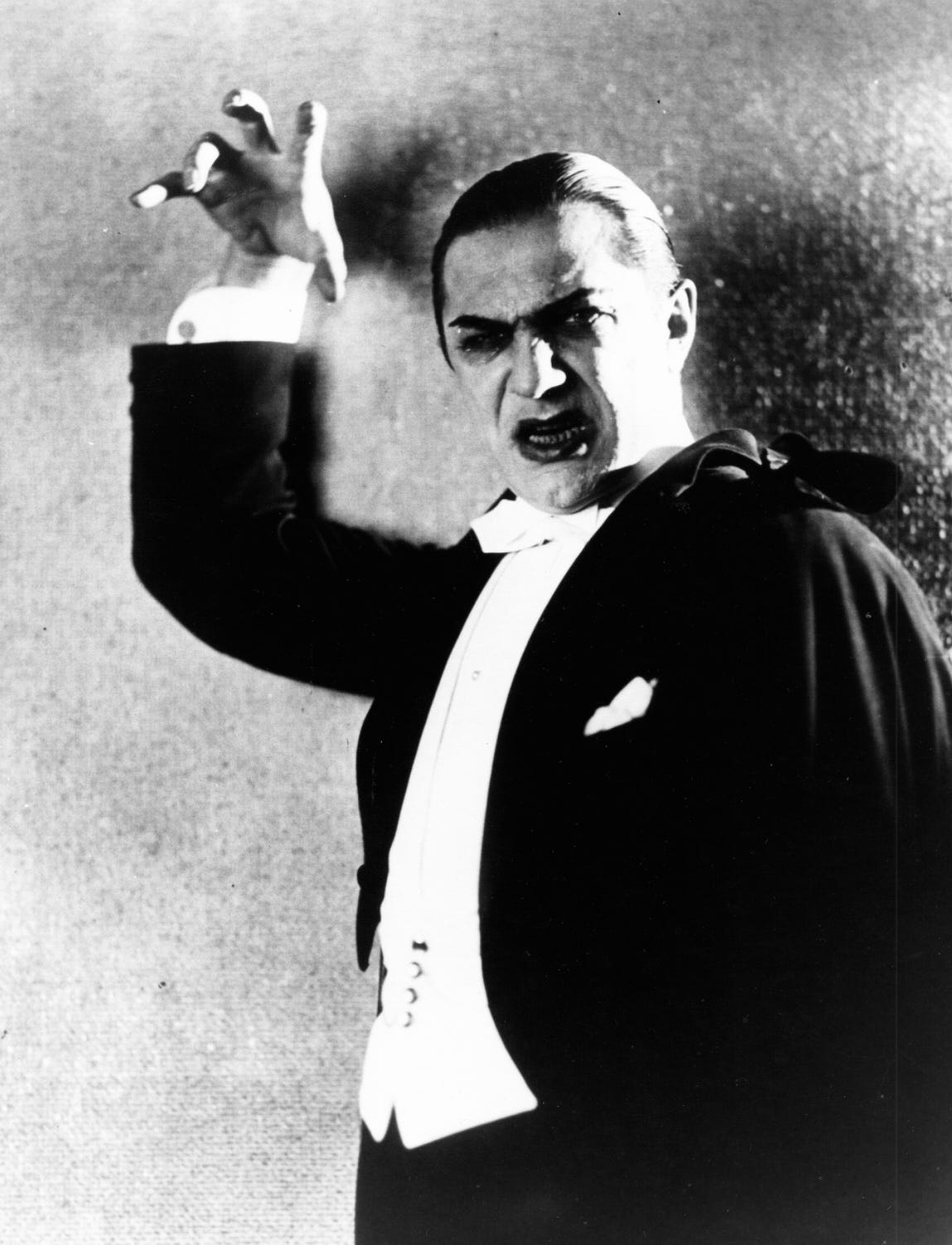
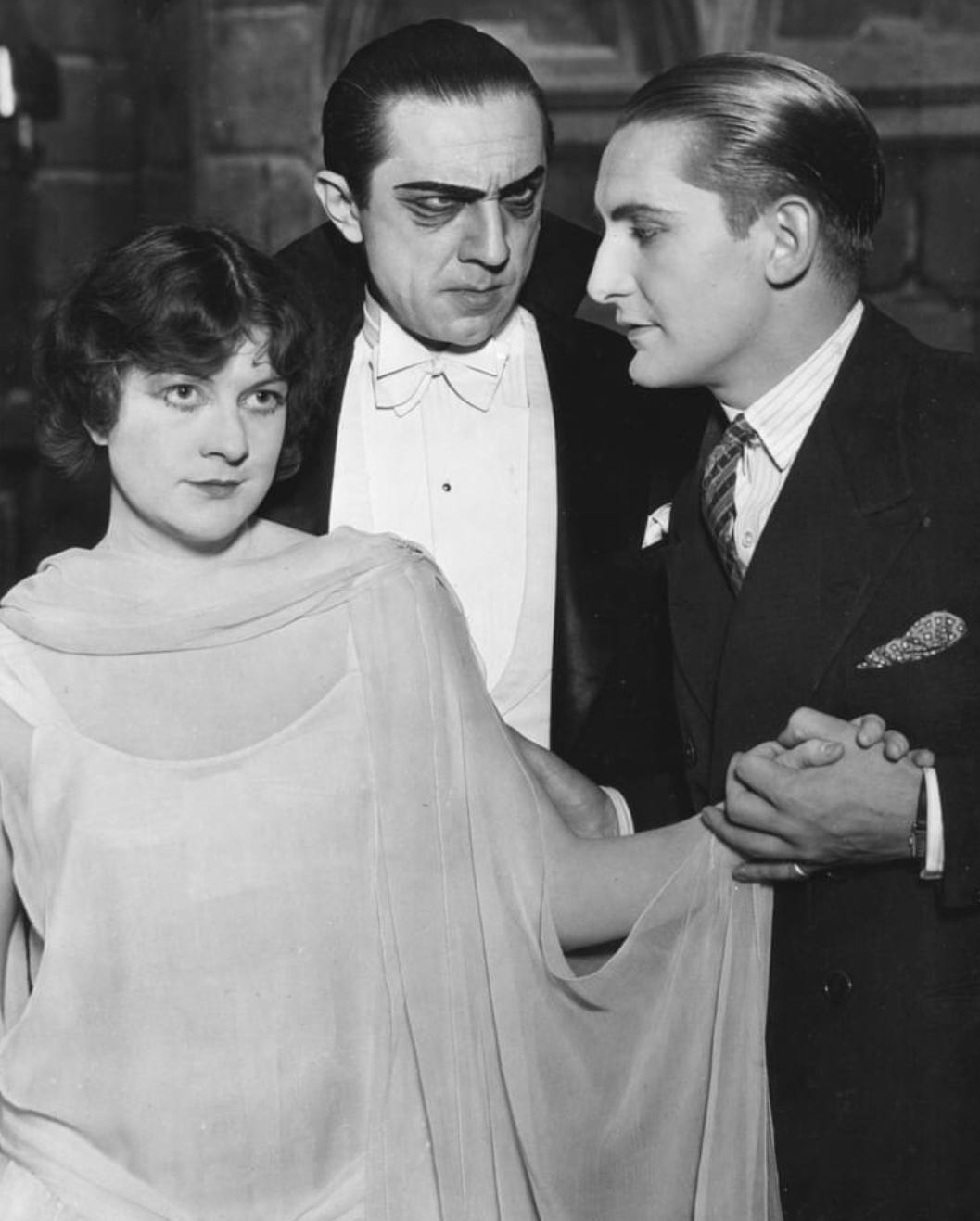
[Above: Lugosi in the stage version of DRACULA (1927). The play—and Lugosi—were a huge hit.]
Meanwhile, Hollywood—particularly Universal—has been interested in shooting Dracula as a Talkie as early as 1928. Rumors circulate that Lon Chaney will play the lead; more reliable talk centers on Conrad Veidt. [6] But protracted negotiations with Florence Stoker—who wants $200,000 for the film rights—bog down until 1930.
Desperate for the role—actually, too desperate—Lugosi steps in for Universal and manages to get Florence down to $40,000. [7]
Universal producer Carl Laemmle, Jr.—whose father had famously started the company—notices. And no good deed goes unpunished…
Realizing that he can use Lugosi’s desperation against him, Junior offers him the role…at $500 a week. Take it or leave it.
“It was a studio power play at its baldest and nastiest,” David J. Skal will write. “In all his scraping and supplicating the actor had more than tipped his hand, and blown the poker game. Universal knew it could dictate terms, and the Dracula they desired was far too thirsty to put up a fuss.”
Lugosi takes it. How can he not?
“Lugosi no doubt rationalized,” Skal says. “A financial concession, yes, but what an investment! The exposure. The acclaim. The future! Well-meaning friends surely urged him to sign. How could anyone turn down work, these days? And a starring part in a movie by the Laemmles [Best Picture Oscar winners for 1930’s All Quiet on the Western Front]! There were actors on breadlines.”
Universal spends lavishly, dropping nearly $442,000 making Dracula. Lugosi gets $3500 of that—a little less than $59,000 today.
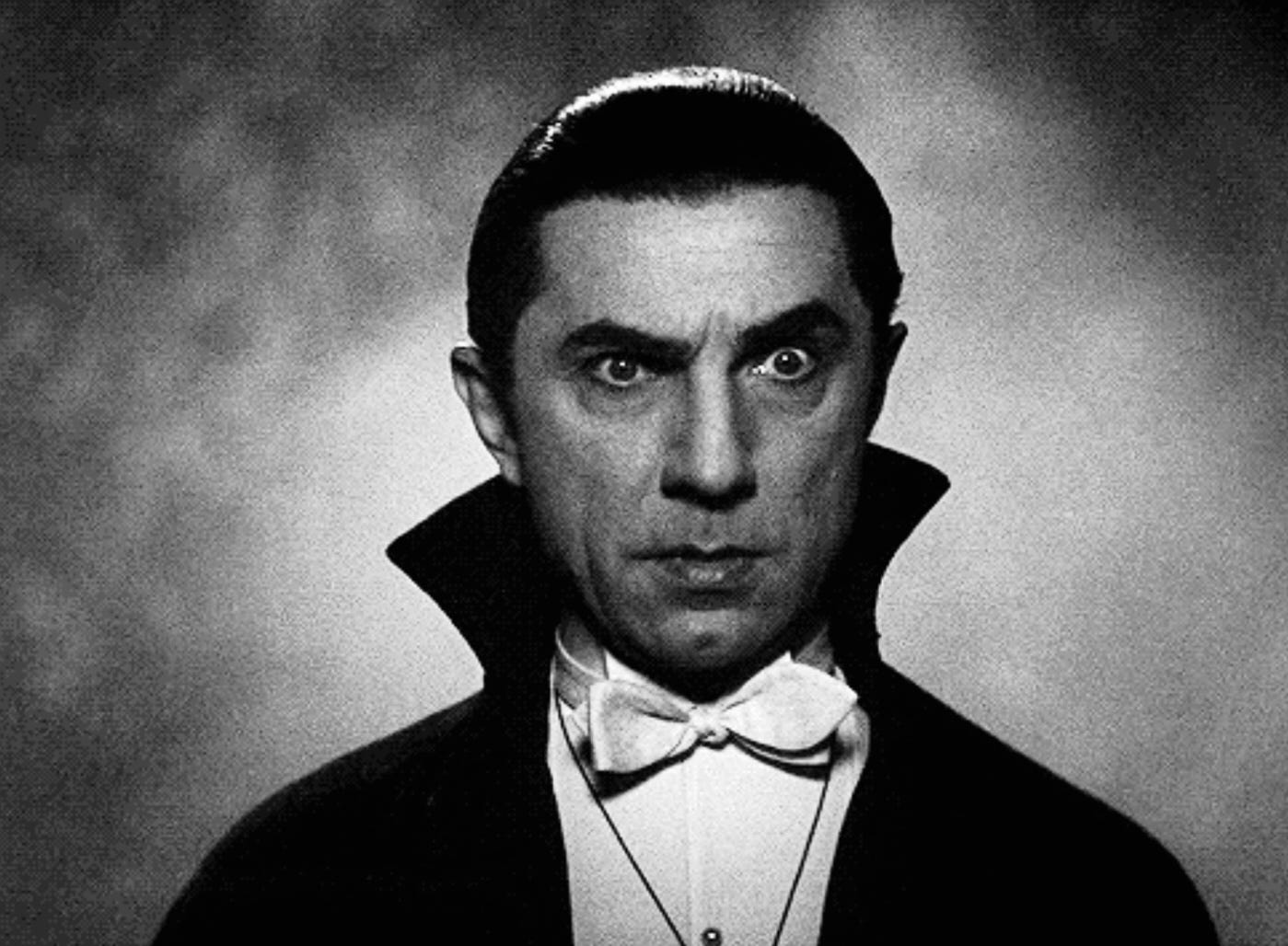
[Above: Lugosi in DRACULA (1931). In order to secure the part, he helped Universal negotiate with Frances Stoker for the film rights. Universal took advantage of his hunger for the part, paying him only $3500 for his iconic portrayal in the movie.]
Thursday, February 12, 1931. Dracula opens. It’s a smash, making $112,000 in its first eight days. It will be the ninth biggest hit of the year, and is instrumental in saving Universal from bankruptcy. The suits are obviously thrilled—and immediately plan to star Lugosi in Frankenstein.
Lugosi is thrilled as well. The part of a driven, brilliant scientist with a mad dream is right in his wheelhouse. Robert Florey, Frankenstein’s screenwriter and proposed director, certainly agrees with him. But Junior Laemmle does not. He sees Lugosi as a horror guy—and, at nearly 49, too old to play the doctor. Lugosi is assigned the part of The Monster.
Lugosi is appalled. In his opinion—which he doesn’t hide—anyone can play this “scarecrow.” Single again—two more wives have come and gone by now—he’s been getting bags of fan mail from flirty women thanks to his sexy take on Dracula. There is no way the ladies are going to gush over him as The Monster.
In spite of his objections, a test reel is scheduled. The actor, who is used to doing his own makeup, fights with makeup artist Jack Pierce right up until cameras turn—“Lugosi thought his ideas were better than everybody’s!” Pierce will complain later.
The test is a bust. Junior reportedly breaks out in guffaws at the site of Bela in costume.
As a result, Lugosi gets his wish—he won’t be playing The Monster. But he won’t be playing the doctor, either. He and Florey are off the film. It’ll be up to director James Whale and actors Colin Clive and Boris Karloff to make cinema history that summer.
Lugosi, meanwhile, becomes a U.S. citizen. He also enjoys the high-life. Parties at his digs. Expensive Havana cigars. Wine, women, song. He isn’t rich, but he spends money like he is. Plus, he’s extremely generous and a soft touch; friends who need a hand-out know they can count on him.
He continues to perform powerfully in films—Murders in the Rue Morgue, White Zombie, Island of Lost Souls. But none make as much money as Dracula. And he himself continues to be underpaid. By October of 1932, he’s facing bankruptcy.
Frankenstein, meanwhile, is a massive hit—surpassing even Dracula, and making a star of Boris Karloff.
And an instant professional rival for Lugosi.
“If it hadn’t been for Boris Karloff,” he’ll lament years later, “I would have had a corner on the horror market!”
Bela makes a vow: he will never turn down a part again.
January 31, 1933. Los Vegas. Bela Lugosi marries Lillian Arch.
Lillian is the attractive daughter of a local Hungarian family. She’s been working for the actor as a general secretary and sometime-chauffer.
She’s also nearly thirty years his junior. This has set Bela at odds with her father, formerly a good friend.
The marriage will last for twenty rocky years. Though he oozes Old-World charm, by his own admission, Bela is something of a control freak. He refers to himself as “Master of the House,” and picks out her clothes.
Discourages the use of makeup or perfume.
Pushes her hair off of her ears.
“Men like natural women, I submit,” he explains. “It is a natural instinct.”
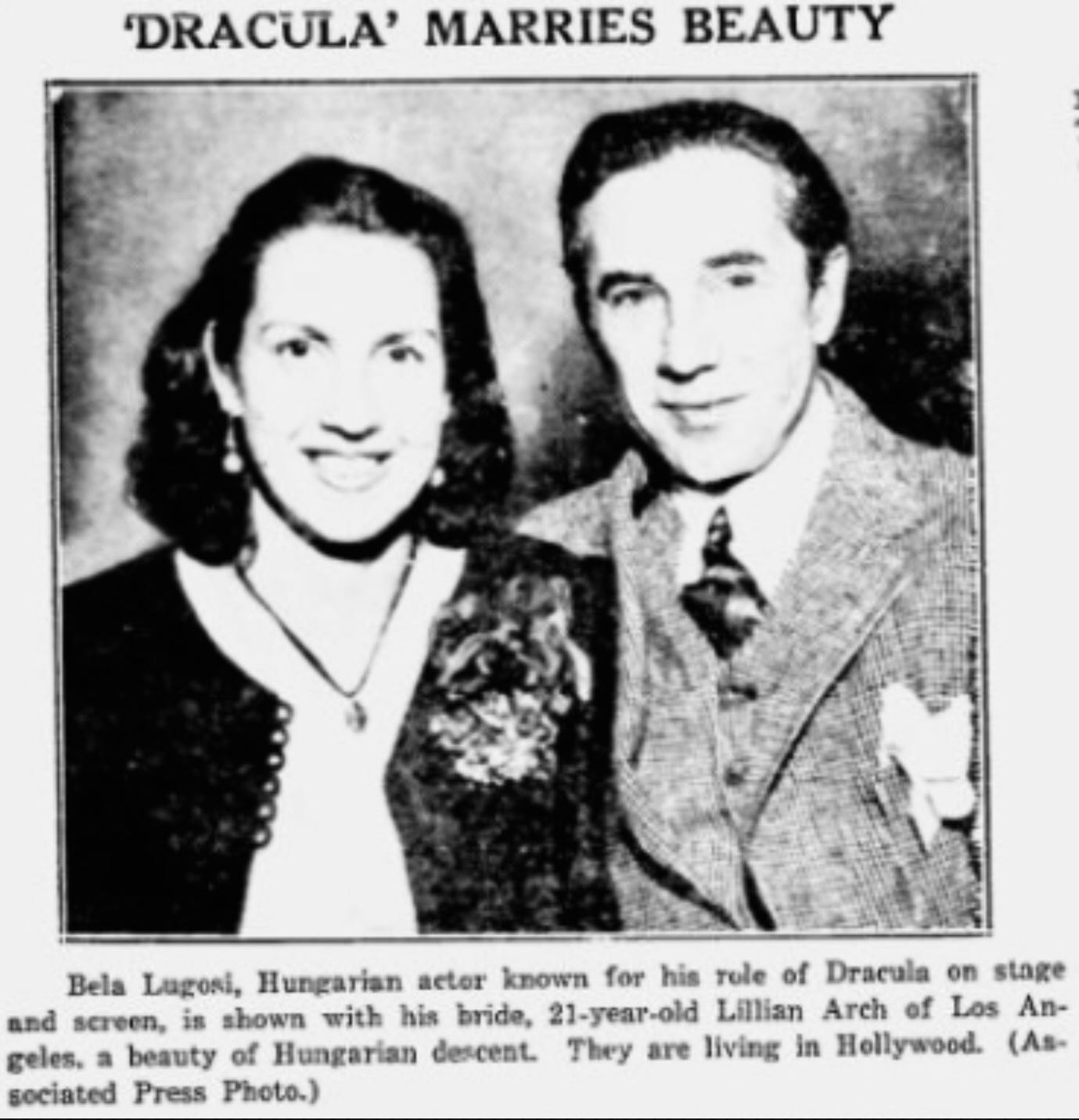
[Above: Lugosi married for a fourth time in 1933. His bride, Lillian Arch, was nearly 30 years his junior. Though Bela was often warm and friendly, he was also—by his own admission—something of a control freak at home. The marriage lasted twenty years, and yielded one child: Bela George Lugosi.]
Soon, Universal is pairing him up with Karloff—by now billed as KARLOFF—in wild films like The Black Cat and The Raven. Both movies are superb, and feature excellent performances by the stars. But the latter is unfairly blamed for getting horror films banned in Britain, and Hollywood—tired of battling censor Joseph Breen on this side of the pond—stops producing scary flicks.
A moratorium on horror films puts a moratorium on Lugosi’s income as well. He and Lillian lose their house, their servants, their cars. When their son Bela George is born on January 5, 1938, the Motion Picture Relief Fund pays the hospital bill.
“Horror, to me, is learning that you cannot influence your Destiny,” Lugosi wisely states.
August 5, 1938. The Beverly Hills Regina Theater books a triple: Dracula, Frankenstein, Son of Kong. Lugosi notices the lines forming around the block.
“I wonder what is giving away to the people?” he asks. “Maybe bacon or vegetables. But it is the comeback of horror, and I come back.”
He’s persuaded to take the stage at the Regina every night at 10 PM.
Universal—under new leadership—notices, too. They whip up fresh prints of Dracula and Frankenstein and re-release them nationwide as a double bill. The films are massive hits all over again, putting a nearly 50-percent dent in Universal’s losses for the fiscal year.
Britain be damned! New—and, hopefully, profitable—horror flicks need to be made!
November 9, 1938. Director Rowland V. Lee begins shooting Son of Frankenstein. It features Basil Rathbone as the manic son, Boris Karloff—no longer KARLOFF—as The Monster, Lionel Atwill as a wily police inspector…and Bela Lugosi as Ygor, a deranged blacksmith and keeper of The Monster.
It’s a big budget film that becomes a big box office hit, featuring big performances by big names. And Lugosi steals it. [7]
“Lugosi was an undeniably talented performer, who shone especially in ethnic or lowlife characterizations,” Skal writes years later. “His work as the demented Ygor…is a splendid example of the actor at the height of his powers.”
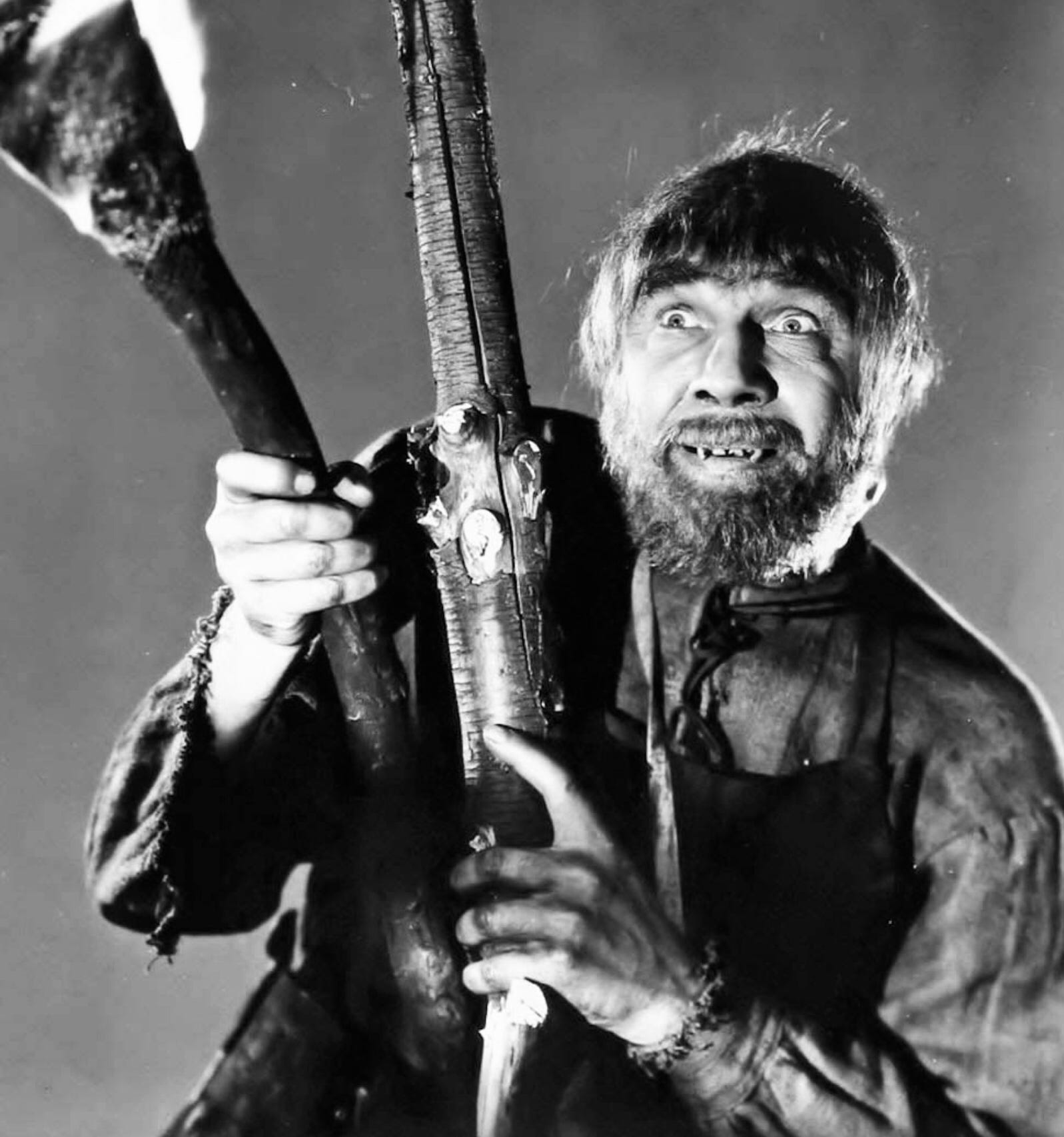
[Above: Bela as Ygor in SON OF FRANKENSTEIN (1939). The role as conceived was a small one, but director Rowland V. Lee and Lugosi expanded it considerably while shooting. The result is one of Bela’s greatest performances.]
More offers come—some with Karloff, whose parts are bigger and always better paid. But turning work down doesn’t pay the bills, so Lugosi soldiers on. He even gets to reprise Ygor—effectively—in The Ghost of Frankenstein (1942), which features Lon Chaney, Jr. as The Monster. In the bizarre climax, Ygor’s brain is popped into The Monster’s head…causing the creature to speak in Ygor’s voice!
And then, things come full circle…
Bela is offered the part of The Monster in Frankenstein Meets the Wolf Man, a sequel to Universal’s box office smash, The Wolf Man (1941). [10]
There is no way 60-year-old Bela is turning this part down again. Besides, the character is more interesting now, at least in his mind: blind, possessed of Ygor’s “sly and sinister” brain, and gifted with evil dialogue that invokes Hitler…a far cry from the “scarecrow” Lugosi perceived it to be back in 1931. He’s even on his best behavior with Jack Pierce.
But problems plague the production. Bela collapses one day on the set under the heavy costume and the heat of the lights. It becomes obvious to producer George Waggner that the strenuous action scenes are going to have to be performed mainly by a stunt man—who, unfortunately, ends up playing the part with stiff limbs like a robot.
Then, a preview of the first cut causes some Universal suits to laugh out loud at The Monster’s lines. Screenwriter Curt Siodmak blames Lugosi’s accent; others blame Siodmak’s over-the-top dialogue. Whatever the reason, all of Lugosi’s utterances—and any references to The Monster’s blindness—are cut, dealing his performance a fatal blow.
Universal unfairly blames all of this on Lugosi.
So much so, that when Siodmak writes the story of what will become Son of Dracula with Lugosi in mind, Universal ignores the idea completely and casts Lon Chaney, Jr. [9] (Lugosi instead makes Return of the Vampire at Columbia, expertly playing the vicious, undead Armand Tesla.)
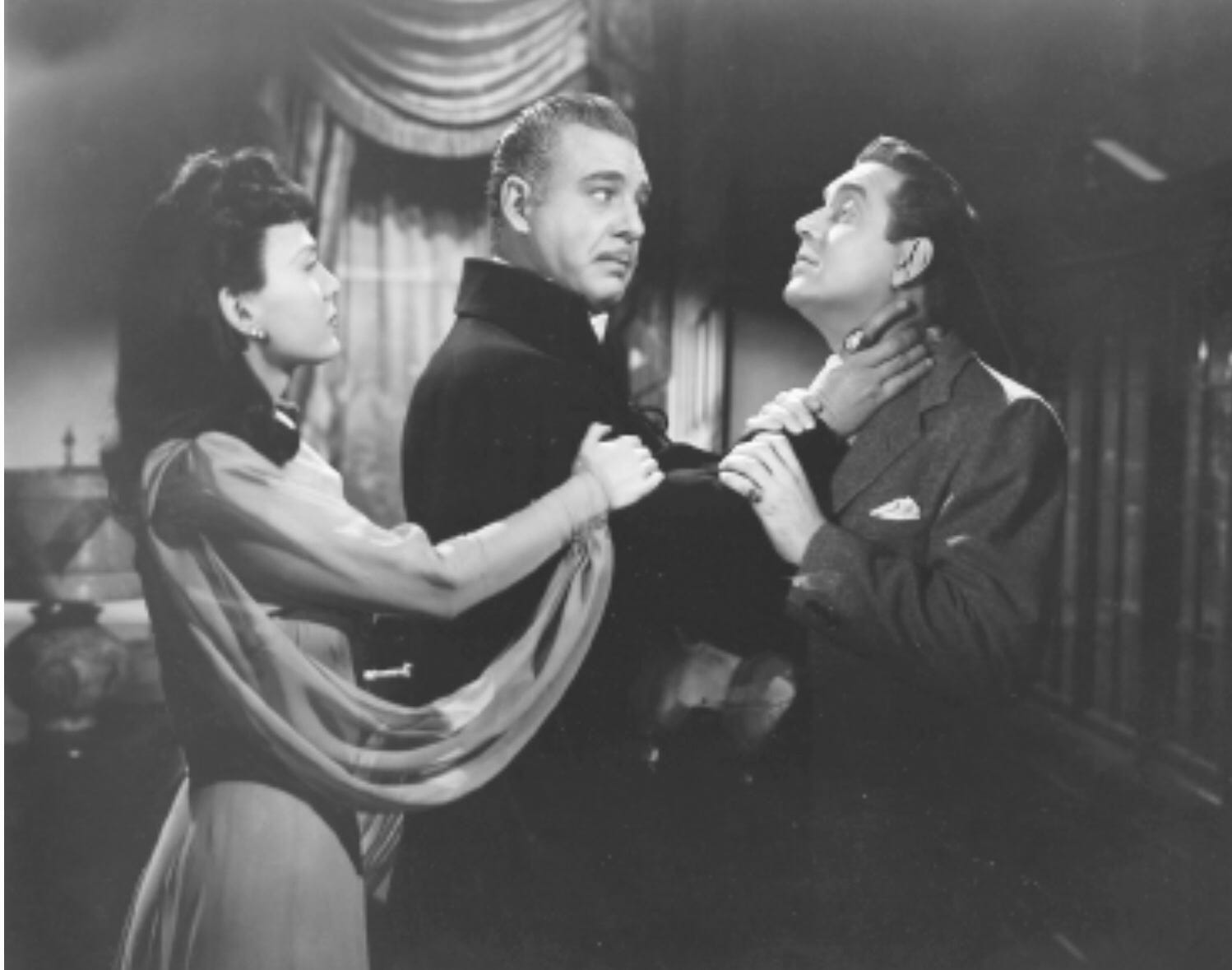
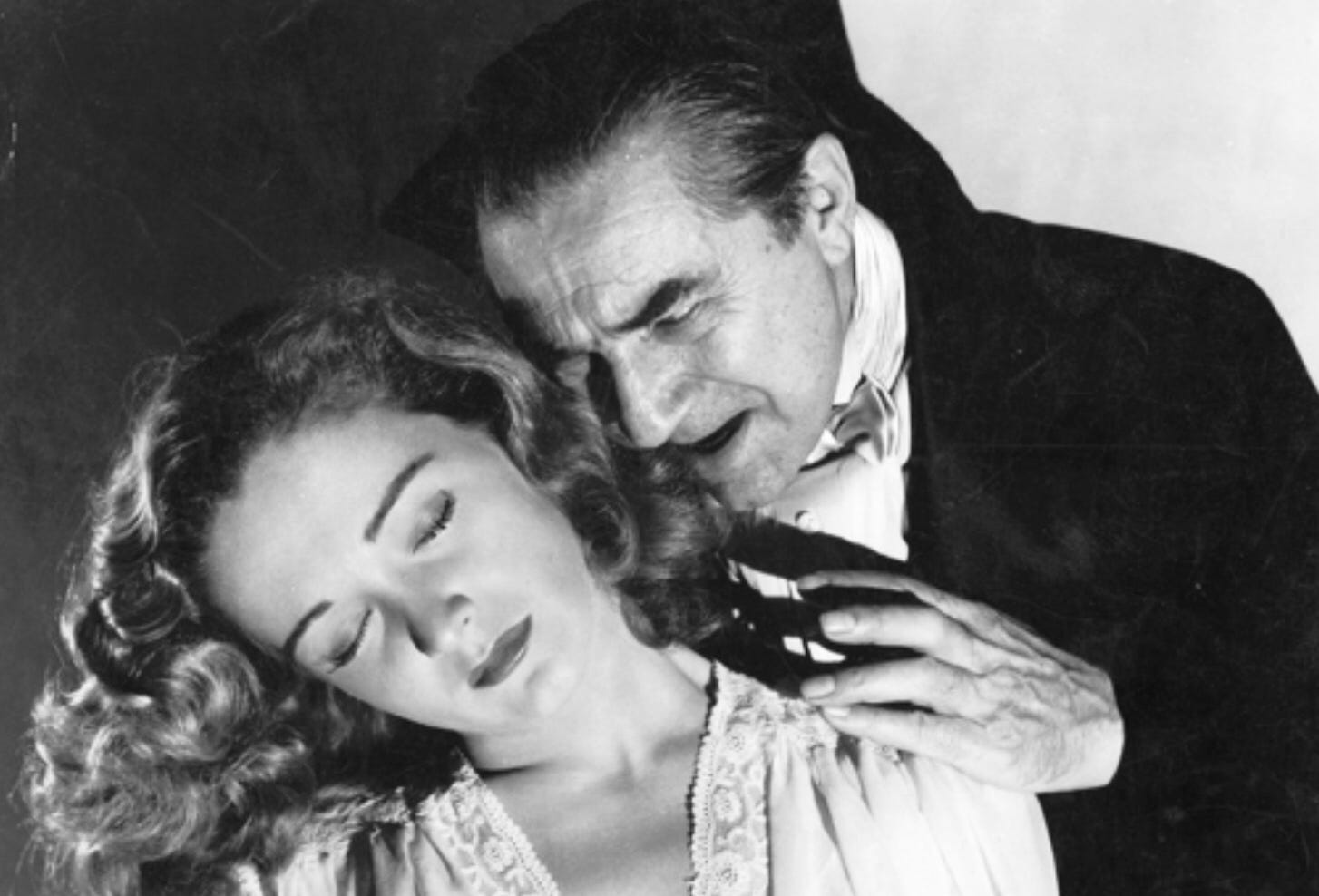
[Above: Lugosi felt slighted by both Universal and Lon Chaney, Jr. when he was passed over for SON OF DRACULA (1943). However, he was excellent as the vicious Armand Tesla in Columbia’s RETURN OF THE VAMPIRE that same year.]
When Dracula is written into the screenplays for House of Frankenstein (1944) and House of Dracula (1945), the part is given to John Carradine. Lugosi isn’t even considered.
Things at home aren’t going much better. His war wounds cause horrible shooting pains in his legs. By 1944, it gets so bad that doctors prescribe shots of morphine. Sadly, he’ll become addicted…and Hollywood will cruelly take notice.
“He was not well at all…” Robert Wise, director of The Body Snatcher (1945), remembered years later. “I heard that he was on drugs at the time. I think he might have been drugged because he was in pain..” [11]
Add to this the fact that his daily intake of Scotch and/or boilermakers has already increased to epic levels. Plus, Lillian has left him, actually filing for divorce…though they’ll eventually reconcile.
Work in films again dries up. Lugosi advises his people to pass on Dracula revivals, but then bows to the inevitable and takes to the road in productions of both Dracula and Arsenic and Old Lace. He charges $750 a week, but travels hundreds of miles. And life on the road is tough.
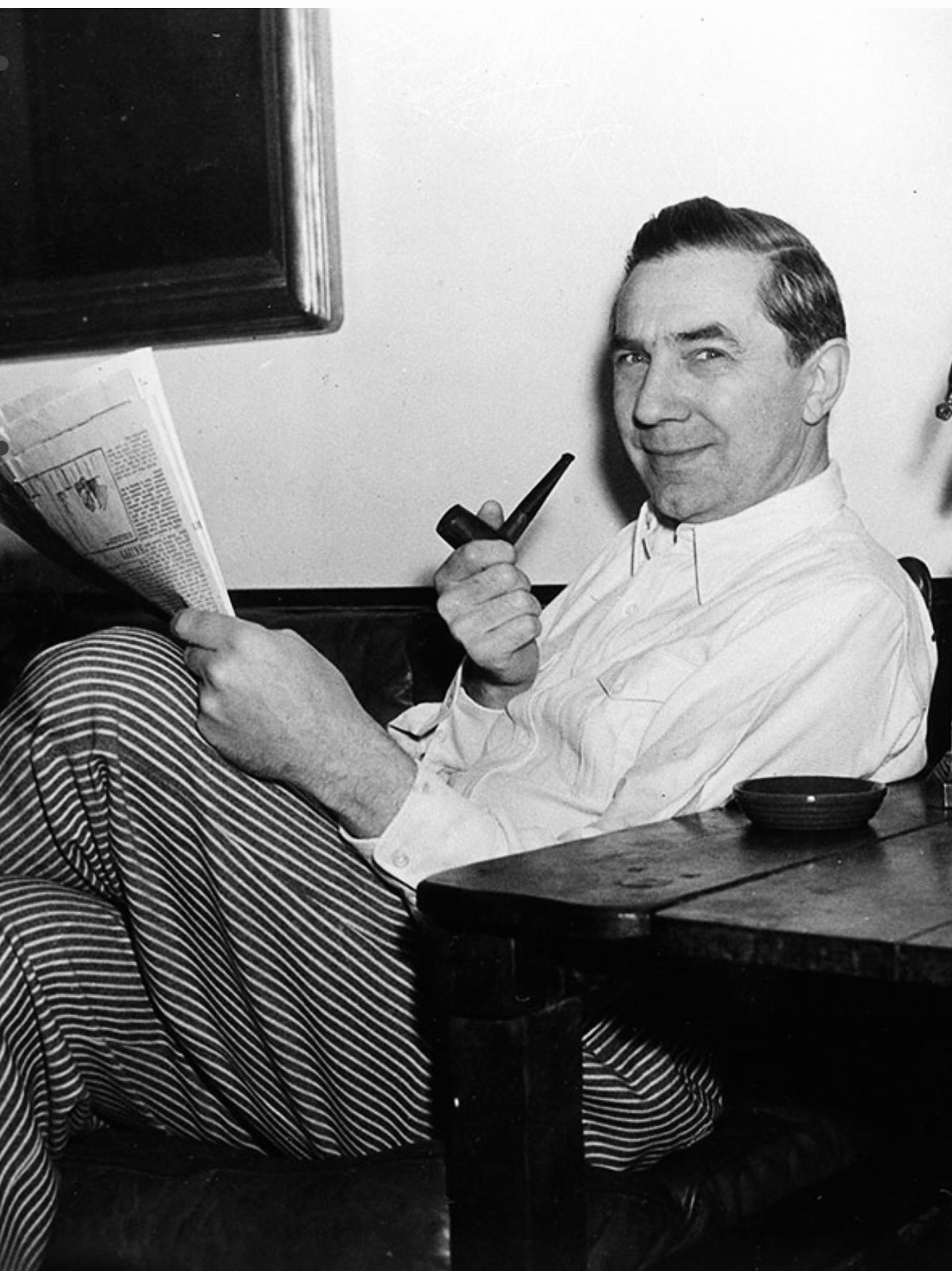
[Above: Bela at home, c. 1948. He enjoyed reading, Havana cigars, and Scotch whiskey. He hosted parties for friends, and was known as a soft touch…when he wasn’t struggling for money himself.]
Always impatient with talent agents—he’d gone through five in the early 1940s alone, believing they weren’t working hard enough to get him parts—Lugosi turns to his friend Don Marlowe to represent him. The actor has heard that the new Universal-International regime is planning The Brain of Frankenstein, an Abbott and Costello vehicle that features Frankenstein’s Monster, The Wolf Man, and—of course—Dracula.
Lugosi wants in.
Though he’s a bit of a con man, Marlowe vows to make it happen. [12] He tells Lugosi a complicated yarn about how he’s shamed studio execs into gifting him with the part as payback for Bela’s Dracula saving the studio in 1931; the facts, according to Lugosi’s biographer Arthur Lennig, are quite different:
“Studio records show that Lugosi had been penciled in for the part when the project first came under development in 1947,” Lennig notes, “before Marlowe visited Universal. Perhaps all that Marlowe did was help clinch the case and obtain a better salary.”
Whatever the actual circumstances, Lugosi is grateful for the job.
“I’ll be truthful,” he’ll say more than once. “The weekly paycheck is the most important thing to me.”
To that end, he’s hoping to convince the producers to make at least two more Dracula films.
“There is enough material in the original novel for half a dozen pictures,” he asserts.
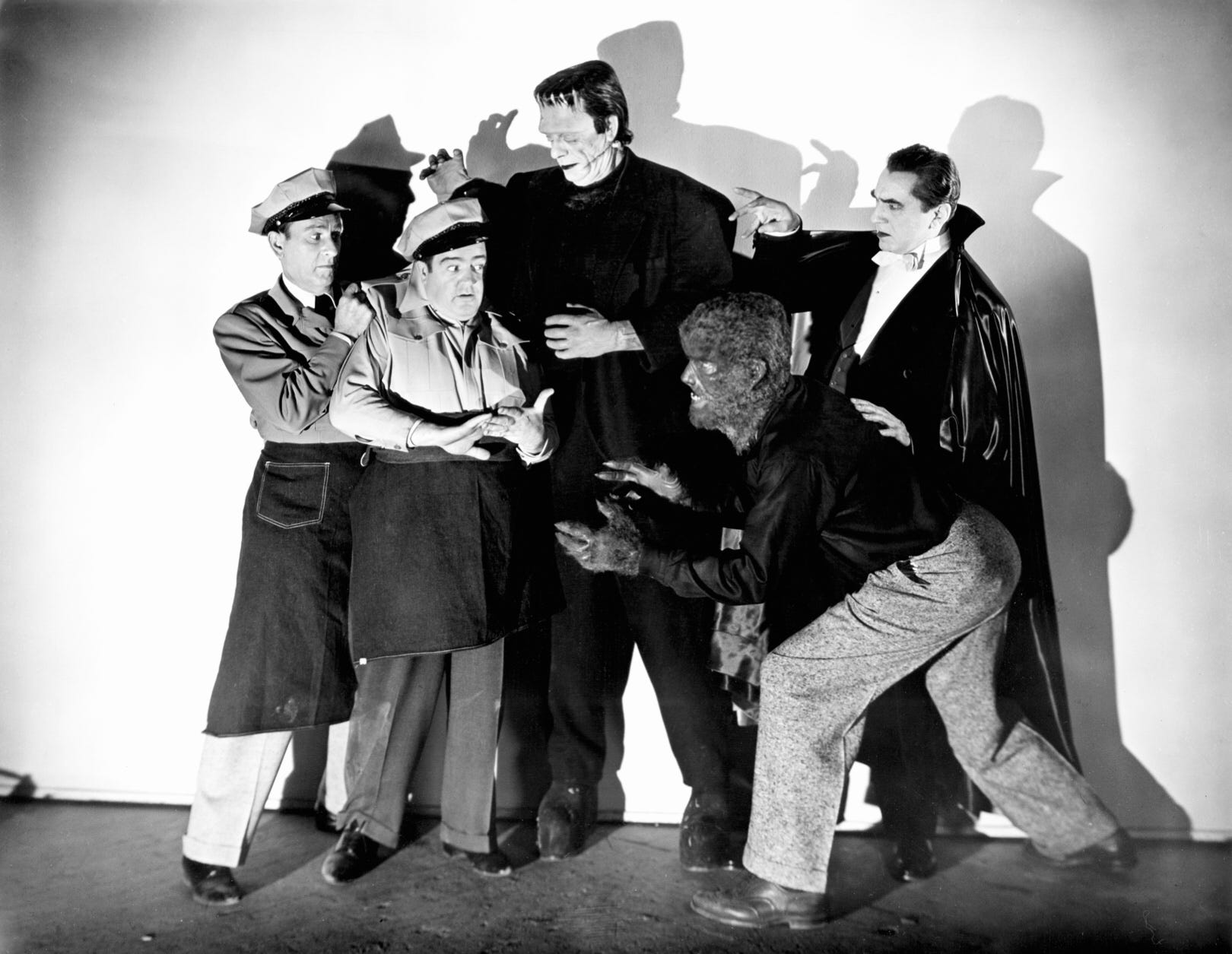
[Above: ABBOTT AND COSTELLO MEET FRANKENSTEIN puts the comedians at odds with The Monster, Dracula, and The Wolfman. Though grateful for the part, A&C’s offstage antics made the shooting tough on Lugosi.]
But it’s not just the money. Bela knows how associated he is with Dracula, and he knows what a break he’s caught by securing the chance to play the part in a major motion picture once again. Perhaps this will restore his reputation with the studio and reopen doors for him?
He’s certainly on his best behavior during the shoot.
“He was quite a gentleman,” co-star Jane Randolph will say. “He really liked doing Dracula. He did not hint that he felt trapped by the character. He seemed proud of it.”
He’s also delivering one of his greatest performances.
This is partially thanks to Bela’s director, Charles T. Barton. The five-foot-two, 45-year-old Sacramento native has a great respect for the actor, and has staged scenes to emphasize Lugosi’s hypnotic blue eyes. Plus, Barton is working on his fifth Abbott and Costello production, so he knows the ropes. His main appeal for Universal-International is that he gets along with Lou Costello, who has been very vocal about how much he disapproves of the project.
“A lot of people showed fear, and that’s what he loved, so he’d walk all over them,” Barton will tell Greg Mank about Costello years later. “But for some reason, with me—and I don’t know why in the hell it was—we got along even better than brothers.”
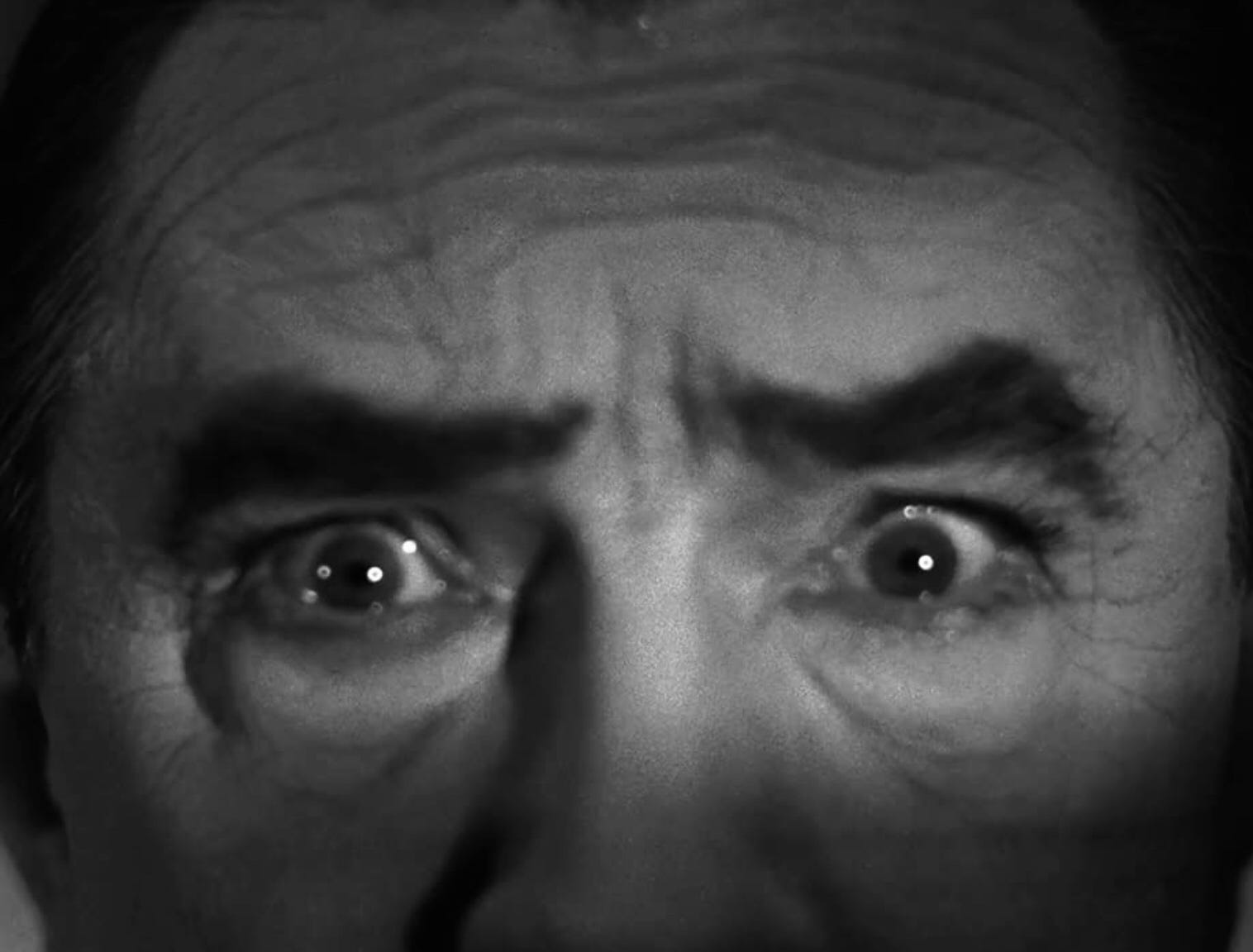
[Above: Director Charles Barton wisely emphasized Lugosi’s hypnotic blue eyes in the film.]
This being an Abbott and Costello set, things are typically chaotic.
There’s Abbott and Costello’s paid jester Bobby Barber, bringing in pies to throw and getting eggs cracked on his bald head. The diminutive, shifty-eyed actor even scores a bit part in the film as a waiter.
Then, there’s Costello’s refusal to learn his lines from a script he still dislikes.
“He just wanted to stand up and do routines,” Barton explains.
Several bits of business from A&C’s longtime joke-meister John Grant ameliorate Costello’s concerns a little, though fellow screenwriters Robert Lees and Frederic Rinaldo feel such things don’t belong in the script.
“Grant was a problem for us,” Lees will remember in 2008. “After we’d work very hard to get a story together, Grant would come in with something and they’d put it in just because it was from Grant.”
These fly-by-the-seat-of-your-pants antics don’t sit well with Lugosi. Initially amused, Lugosi’s tolerance erodes as takes are blown and time is wasted.
This isn’t the way professionals are supposed to behave.
“There were times when I thought Bela was going to have a stroke on the set,” Barton remembers. “You have to understand that working with two zanies like Abbott and Costello was not the normal Hollywood set. They never went by the script.”
Lugosi handles the situation by glaring at the offenders in his inimitable way.
“We should not be playing while we are working,” he’ll intone more than once.
Not that it does any good.
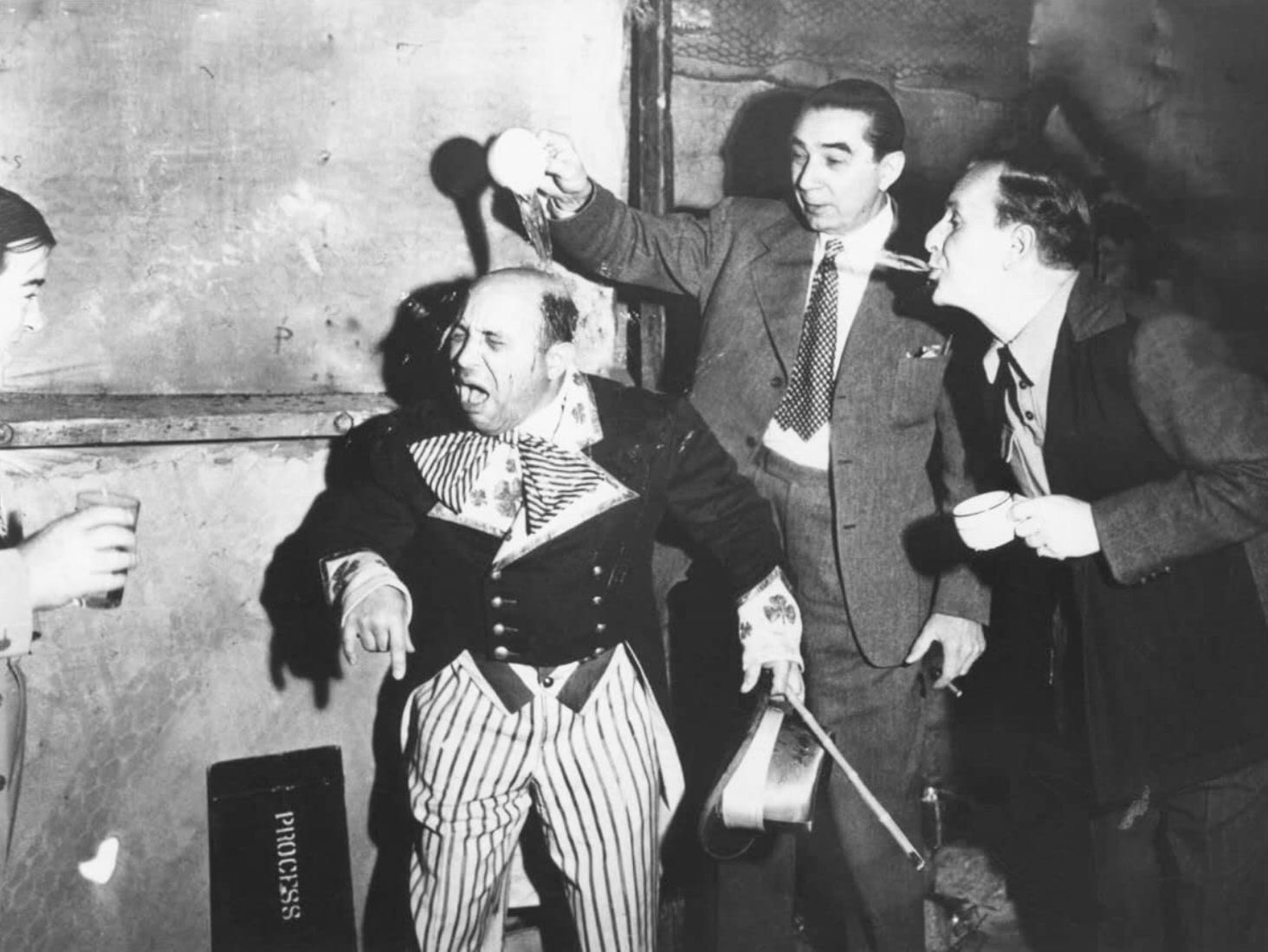
[Above: Initially amused by A&C’s between-the-scenes antics, Bela soon tired of blown takes and wasted time. “We should not be playing while we are working,” he would say. Here, Bela helps A&C torment comedian Bobby Barber.]
Though Bela and Glenn Strange as the Frankenstein monster are not fair targets in the pie wars—Strange because The Monster’s eyelids partially blind him, and Lugosi simply out of respect—that doesn’t shield them from the rest of the shenanigans.
Typical are Abbott and Costello’s on-set card games that eat up their salary as well as precious production hours. Then, there are the times when the comics go home for the night…and don’t return until what feels like days later.
As a result, the film will take a week longer than scheduled, tacking $33,000 more onto the bill.
“All three of the ‘monsters’ were the nicest,” Barton will say. “The real monsters were Abbott and Costello!”
Sure, Lugosi is cool to Lon Chaney, Jr.—who is reprising The Wolfman—believing that Chaney’s drinking on the set is unprofessional…and still nursing a grudge over Lon’s casting as the vampire in Son of Dracula. (Chaney gets even with him by sarcastically calling him “Pop.”)
But Lugosi takes comfort in the fact that Dracula is treated with care. The script includes ripe lines that are delivered by Lugosi with just the right touch of irony.
“There is no burlesque for me,” Lugosi will explain. “All I have to do is frighten the boys, a perfectly appropriate activity. My trademark will be unblemished.”
An unhappy Chaney certainly can’t say the same about The Wolfman.
A scene in the woods opposite Costello is the worst. Wildly expanding on the mild slapstick indicated in the screenplay, the five-four, two-hundred-pound comic repeatedly punches and kicks the hairy, inexplicably clumsy beast stalking him in the woods, believing it to be Abbott in a mask; this completely destroys any fear Chaney might generate.
And though his final scenes—which involve chasing Dracula—are handled more realistically, the overall impression the film makes is that The Wolfman is a clown. So even though he’s collected $10,000 for the role—just shy of $117,000 at this writing—the film leaves a bad taste in his mouth. [13]
“Abbott and Costello ruined the horror films,” Chaney will growl years later. “They made buffoons out of the monsters.”
They certainly did in The Wolfman’s case, though Strange’s Frankenstein monster is treated with respect…mostly.
Meanwhile, Lugosi steals the film.
As many critics have noted, makeup artist Bud Westmore—who’d replaced Jack Pierce—undoubtedly thought Bela was too old for the part, and buried the actor in obvious face powder, hair dye, and lipstick. But, as more than one critic has also noted, the heavy makeup adds something to the character. I believe it actually enhances Dracula, giving him an otherworldly, undead look.
“Though very obvious,” writes Gregory William Mank, “these cosmetics brought a strangely proper touch to Lugosi’s Dracula, underscoring the vanity o the ancient count.”
Lugosi himself is marvelous in exploring Dracula’s moods, which—it must be said—are more varied than in the 1931 original. Certainly, Lugosi was effective in communicating Dracula’s charm, sexual power, anger, hypnotic ability, and brief tinges of regret in the earlier film—and does so again here. But the mores of 1931 dictated more theatrical, stagey acting techniques…techniques that look antique these days.
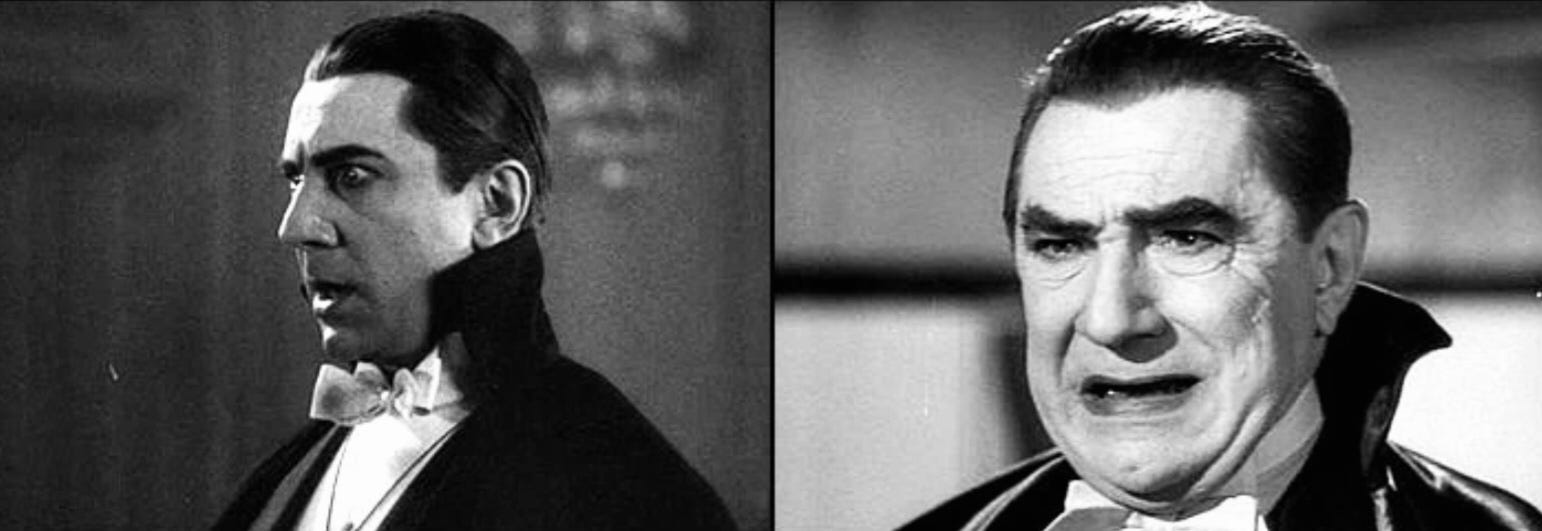
[Above: Lugosi as Dracula in 1931 and 1948. Though iconic in 1931, the mores of the day dictated more “stagey” acting. By 1948, such pretenses had been dropped. Lugosi’s dialogue flows expertly as a result.]
Film acting had come a long way by 1948, and so had Lugosi. Gone are the long pauses in Dracula’s speech. This Dracula speaks more quickly, but with no less authority…and demonstrates a creepy, ironic humor that Lugosi perfectly embodies.
“Ah, you young people,” he muses at one point to Costello. “Making the most of life…while it lasts.”
It’s only one of many, many expertly delivered lines.
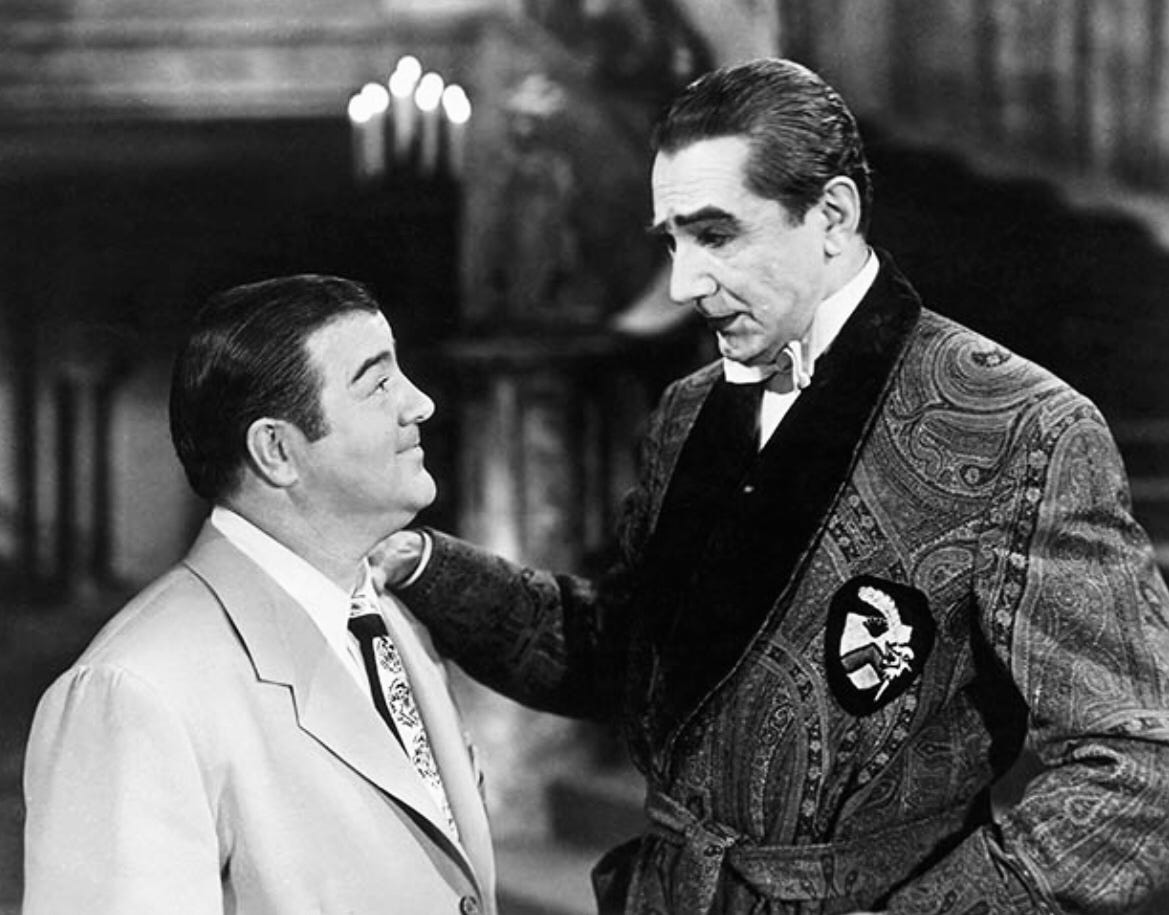
[Above: “Ah, you young people. Making the most of life…while it lasts.” An added aspect to Dracula’s character in 1948 is a sly, ironic sense of humor. Lugosi delivers these ripe lines perfectly.]
Certainly, there are perceived flaws in the film. A victim of The Wolfman, for example, lives…but doesn’t become a werewolf. And Dracula is glimpsed briefly in a mirror. [14] Still, none of these are Lugosi’s fault. He gives his all, as he always did, and delivers what I believe to be one of his Top Five performances. [15]
The film is released, of course, as Abbott and Costello Meet Frankenstein. It’s a huge hit, raking in $3.2 million—about $350 million at this writing. It reignites Bud and Lou’s career, and gives Lugosi a great deal of hope for his future.
Sadly, he’s wrong.
To begin with, his hoped-for Dracula sequels never materialize. And—in spite of how undeniably great he is in the picture—the new Universal execs take a page from the former playbook and go back to ignoring Bela Lugosi.
So, Abbott and Costello eventually meet The Invisible Man, Dr. Jekyll and Mr. Hyde, The Mummy, and the Killer—Boris Karloff.
But—as far as Universal is concerned—there is no room in any of this for Lugosi. What a shame this is, for Lugosi could have been a magnificent foil for A&C again in, say, the role of a mad scientist.
“Lugosi’s career declined irretrievably after his second film appearance as Dracula,” David J. Skal correctly observes. “After Abbott and Costello Meet Frankenstein, he would never again have a speaking role for a major studio nor was he able to interest Universal, or any other studio, in a remake of Dracula.”
In 1957, interest in the Universal Monsters soars once again thanks to the sale of the films to TV in the Shock Theater package.
But Lugosi misses out. Sadly, he has died on August 16, 1956 at the age of 73.
Abbott and Costello Meet Frankenstein should have been not only a triumph artistically for Lugosi—which it undeniably is—but a financial one as well. Studio executives should have reveled in his hypnotic, humorous, towering performance, and set screenwriters on similar projects for him posthaste. That they didn’t is one more cheap punch to the gut in a life filled with unhappy—mostly underserved—slaps.
Still, as it stands, Abbott and Costello Meet Frankenstein is the gateway to the Universal Monsters for generations, mine included.
And Bela Lugosi as Dracula is a huge reason for that.
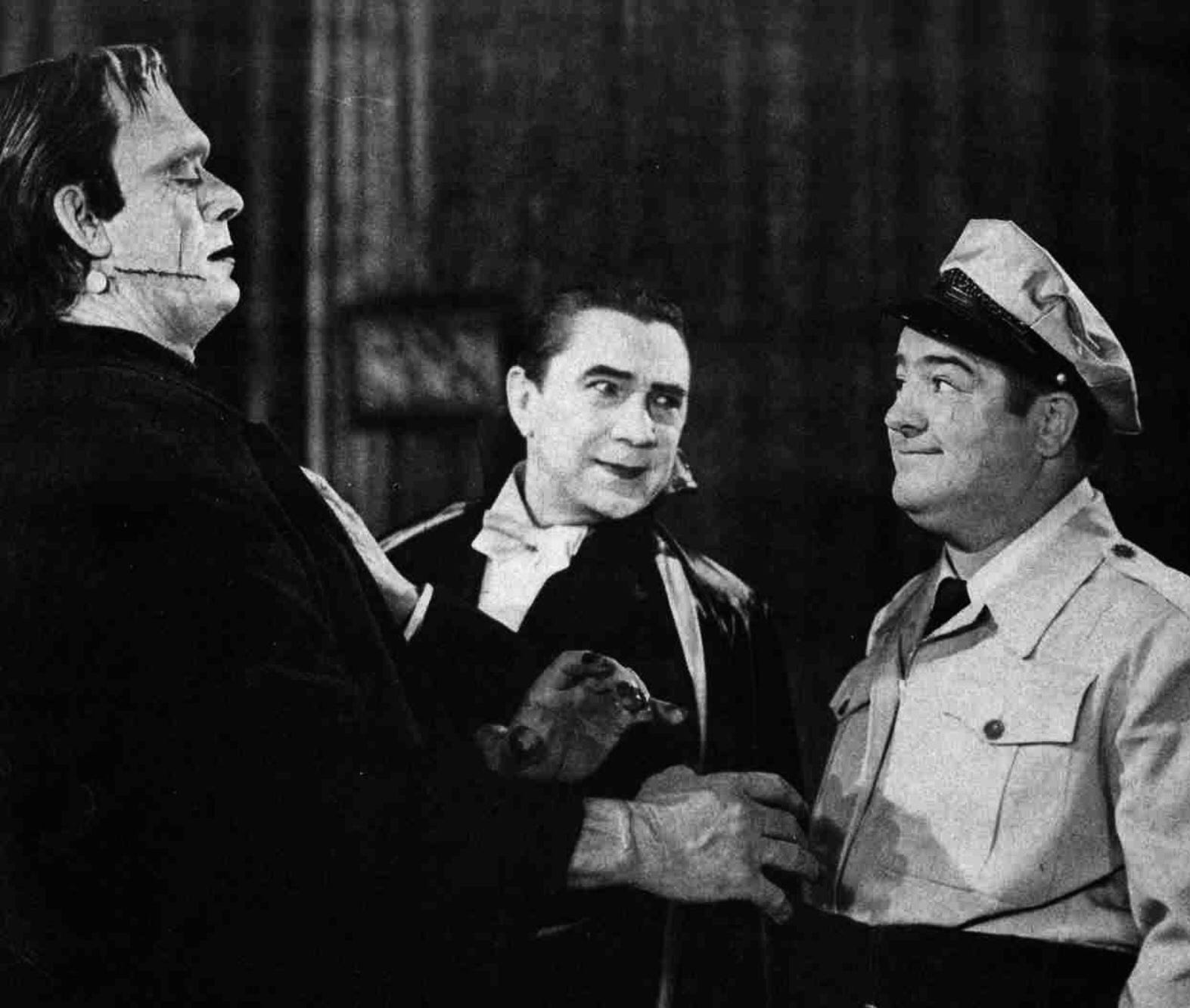
[Above: ABBOTT AND COSTELLO MEET FRANKENSTEIN is the gateway for many to the Universal Monsters, and should have revived Lugosi’s career. Sadly, it was not to be. But his brilliant performance can still be savored.]
Notes
[1] Many believe Dracula was released on February 14, 1931. David J. Skal has debunked this. See Hollywood Gothic, p. 194.
[2] It is now part of Romania, and is called Lugoj.
[3] Lugosi will eventually marry five times: Ilona Szmick (1917-1920), Ilona von Montagh (1921-1925), Beatrice Woodruff Weeks (1929-a bit later that year), Lillian Arch (1933-1953), Hope Lininger (1955-his death in 1956).
[4] Florence Stoker had been apoplectic upon discovering the book had been made into a film called Nosferatu in Germany…without her permission. She sued, but the production company was already bankrupt. She then attempted to have all prints of the film destroyed; obviously, she didn’t win that argument either.
[5] Lugosi almost turned the part down, since his character had less dialogue than he was used to. Lucky for all concerned, he changed his mind.
[6] According to David J. Skal, it wasn’t likely that Chaney would ever take the role anyway. To begin with, he was under contract to Metro. Then, too, he was suffering from “a nagging bronchial complaint”—actually, the cancer that would soon kill him. Finally, Universal—in a rushed attempt to get a sound version of Chaney’s Phantom of the Opera out in theaters—“made a legalistic end-run around Chaney’s contractual refusal to have his voice dubbed by introducing a shadowy figure, ostensibly the Phantom’s helper, who would speak the necessary dialogue and be accepted by the inattentive audience as Chaney himself. None of this could have endeared Universal to Chaney or Metro, and may well have been the nail in the coffin for Chaney’s ever acting in Dracula…” (Skal, p. 155). Chaney biographer Michael F. Blake concurs: “[T]he first choice for the role was actor Conrad Veidt, but his thick German accent put an end to his career in American sound pictures for many years. Chaney was the studio’s second choice, even though the reality was that Universal’s chances of obtaining his services were extremely slim…Chaney’s contract with MGM was not about to expire…It was also doubtful that MGM…would have loaned Chaney out to a competitor, especially Universal…MGM would have demanded a hefty fee from Universal on top of Chaney’s $3,750 weekly salary…MGM would have been legally bound to consider the loan-out as one of the four pictures made during Chaney’s contract year…[MGM] would have lost a considerable amount of money, given Chaney’s large box office popularity, and let Universal reap the benefits” (Blake, A Thousand Faces).
[7] A little less than $674,000 today. Interestingly, the novel Dracula was in the public domain in the U.S.—Stoker had never filed the two required copies. But the $40,000 covered the play concerns as well, so Lugosi’s efforts were worth it…for Universal, at least.
[8] New regime or no, Universal initially plans on skimping on Bela’s salary. They instruct Lee to shoot all of his scenes in one week at a rate of $500 per. According to Lillian Lugosi, Lee was outraged. “I’m going to show those goddamn SOBs that they can’t do that to Bela,” the director tells her. “I’ll keep him on the set from the very first day of shooting to the last minute. I’ll be damned if he doesn’t make as much as Karloff from the film” (Lennig, p. 263).
[9] The plan was originally to have Chaney star in both roles. But the technical difficulties on a limited budget—and Chaney’s penchant to violently complain about Pierce’s makeup—scotch the idea.
[10] Lugosi was infuriated by this, and harbored a resentment of Chaney, allegedly believing the younger actor should have turned the part down (Wiltshire, p. 63).
[11] As Wiltshire notes, “[R]eaders and fans should consider that his dependence on drugs was about pain management, not thrills” (p. 59).
[12] “Richard Sheffield…informed [Arthur Lennig] that Marlowe was basically a con man and ‘a convincing first-class liar’ who apparently stole one of Lugosi’s scrapbooks, which he later attempted to sell for $5,000. For years Marlowe falsely claimed that he was ‘Porky’ in the Our Gang comedies. In 1970, he offered for sale Lugosi’s 1931 screen test as the Frankenstein monster, which he claimed included footage of Carl Laemmle, James Whale, Colin Clive, and Lugosi discussing the test…In fact, [Marlowe’s claim] was almost certainly a cruel hoax” (Lennig, p. 358).
[13] I believe the treatment of his beloved character in the film contributed, at least in part, to Chaney’s nearly successful suicide attempt on April 22, 1948. See my book Chaney’s Baby.
[14] That vampires don’t cast a reflection in a mirror is an invention of Bram Stoker’s. I’ve never cared for the idea myself, believing that if something is corporeal enough to be seen by the human eye, a mirror should be able to reflect it as well.
[15] 1. Dracula (for importance as well as performance); 2. Son of Frankenstein; 3. The Raven; 4. The Black Cat; 5. Abbott and Costello Meet Frankenstein. Honorable Mention: White Zombie. Feel free to disagree!
Sources
Blake, Michael F. A Thousand Faces: Lon Chaney’s Unique Artistry in Motion Pictures. New York: Vestal Press, 1995. Ebook.
Fleck, Bill. Chaney’s Baby. Wurtsboro, NY: Just Pay the Ransom Music, 2021. Print.
Lennig, Arthur. The Immortal Count. University of Kentucky Press, 2003. Print.
Mank, Gregory William. Bela Lugosi and Boris Karloff. Jefferson, NC: McFarland & Company Inc., 2009. Print.
Mank, Gregory William. It’s Alive! San Diego/New York: A.S. Barnes and Company, Inc., 1981. Print.
Skal, David J. Hollywood Gothic. New York: Faber & Faber Inc., 1990, 2004. Print.
Wiltshire, Leo. Reign of the Vampire: A Tribute to the Perseverance of Bela Lugosi. Alpha Omega Kingdom Consulting Group, 2015. Ebook.
The photographs herein are used for educational purposes only. I do not own the copyrights.
Not so sure regarding Lugosi's purported resentment of Chaney Jr. over his drinking or his accepting the role in Son of Dracula. I've got an old Filmfax around here somewhere in which Patsy Chaney is interviewed and says: "Lon liked Bela Lugosi. They were very good friends."
Happy New Year, Bill, and congratulations on an awesome, epic article about Bela. Your prose and scholarly research here is very impressive.
I think we agree that the life trajectory experienced by Lugosi is a cautionary tragedy for the ages. He sometimes undermined himself through pride and an inability to negotiate the Hollywood scene, but Lugosi was undeniably the victim of some very unfair behavior and circumstances.
One aspect I've seen touched on that may help explain why A&CMF didn't stimulate Lugosi's career; in Gary Don Rhodes first book on Lugosi there is an article that speculates on whether Lugosi was a victim of Hollywood's 'blacklist' of suspected communist sympathizers during the HUAC period. The article is credited to someone else (although it appears in Rhodes' book), and I think Rhodes himself tried to debunk the possibility in later works, but I cannot help but wonder if it's a factor -- among several others -- that explain why things didn't go well for Bela post 1948.
FWIW: My Top Five Lugosi Performances:
1. Son of Frankenstein
2. The Black Cat
3. A&CMF
4. Phantom Ship
(aka The Mystery of the Mary Celeste)
5. (A Tie...)
Dracula or White Zombie
Honorable Mention: Ghost of Frankenstein
Of course, whatever our lists, the man was always remarkable. Ciao!