CLASSIC HORROR BEHIND THE SCENES: VINCENT PRICE, ORSON WELLES, AND THE MERCURY THEATRE
Rondo-winning filmmaker Thomas Hamilton will touch on this relatively unknown period in Vincent's life in his new film. Here's a preview.

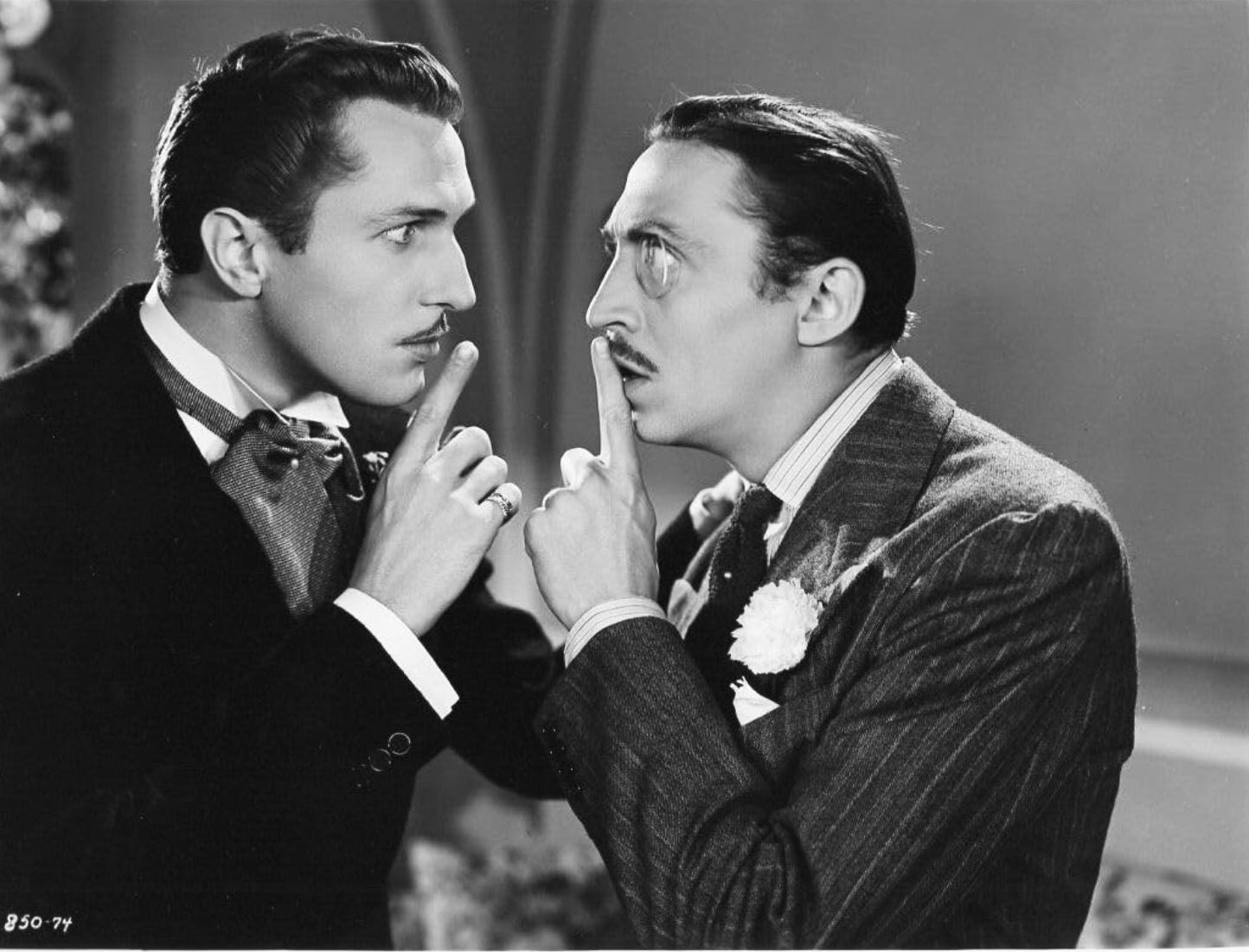
[Above: Vincent Price in his first film SERVICE DELUXE, opposite Mischa Auer.]
By Bill Fleck, author of the Rondo-nominated book CHANEY’S BABY, available here, and the recently Rondo-Honorably-Mentioned CHANEY’S AUDITION, available here.
Did you know? Two-time Rondo-Award winning filmmaker Thomas Hamilton is in the process of making VINCENT PRICE & THE ART OF LIVING. (I’m lucky enough to be a producer on the project.) Check out Tom’s latest HORROR ICONS update here. For information about possibly joining the Ignition Group and helping to get HORROR ICONS produced, click here. Thanks!
Keep your eyes open! Christopher R. Gauthier’s sequel to his Rondo-winning DRACULA NEVER DIES: THE REVENGE OF BELA VORLOCK is on track for a 10/20/25 release. I’m honored to be editing it.
It wasn’t easy for Vincent Price to break into the theater.
As are many beginners, Price had been vexed by the circular reasoning that dictated you can’t get a professional stage job without professional experience…and you can’t get professional experience outside of a professional theater. In 1935, this forced 24-year-old Vincent to lie to an English producer, “with such good effects, that in no time at all, I was given a part in the London production of CHICAGO.“ Talk about acting! (For more extensive information on Vincent’s early life, click here.)
This, of course—two months later—led him to be cast in a leading role of Prince Albert in the play VICTORIA REGINA. When the play was moved to America, Vincent was cast opposite the estimable Helen Hayes. This made the enthused Vincent a rising star. Hayes wisely advised Vincent to stay in the east and take summer stock parts to expand his range.
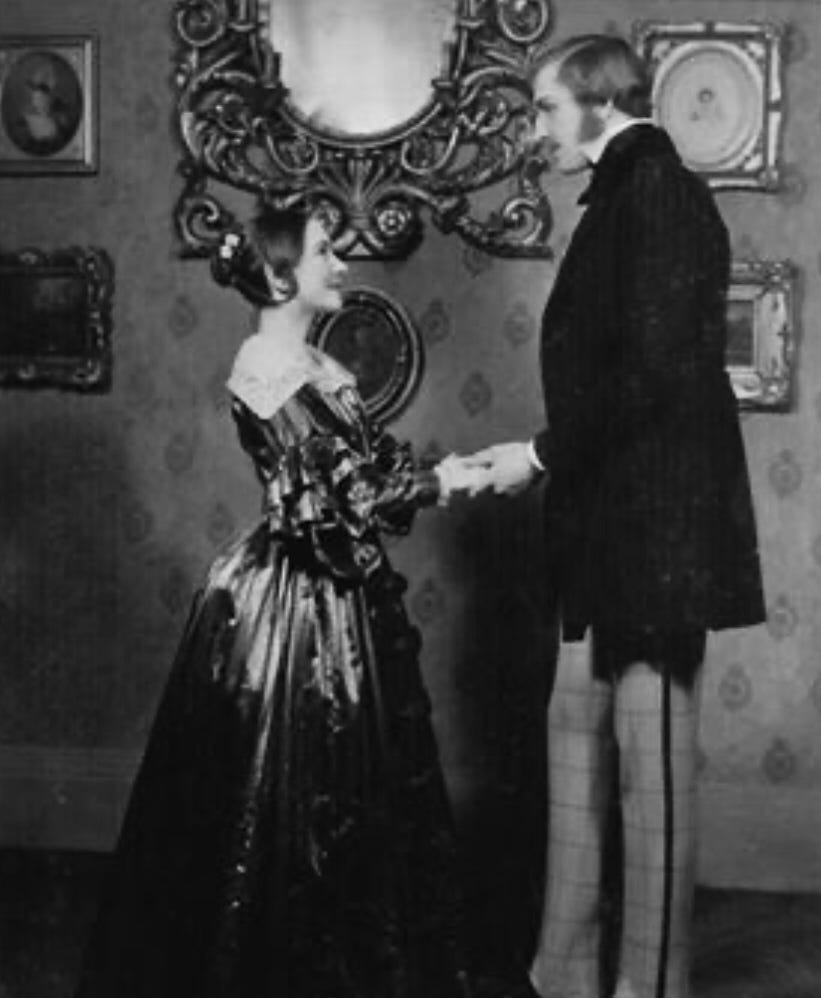
[Above: Helen Hayes and Vincent Price in VICTORIA REGINA, the play that made Price a star.]
It was during this time that Vincent met actress Edith Barrett, who would eventually become his first wife…and also the mother of Barrett, their son.
It was also during this time that Hollywood reached out to him. Vincent was first offered a contract at MGM. But he turned this down because he wanted the option to be free for six months each year to work on the stage. As it turned out, Universal Pictures was okay with this condition, and Vincent signed a seven-year contract.
Several film projects were suggested for him, but they never came to fruition. However, the young Price continued to work on the stage.
In late 1937, Vincent was approached by Orson Welles and John Houseman, who had formed the Mercury Theatre. Classic horror film fanatics will know that Houseman, 35, had once been married to Zita Johann of THE MUMMY (1932) fame, which—of course—starred, Boris Karloff.
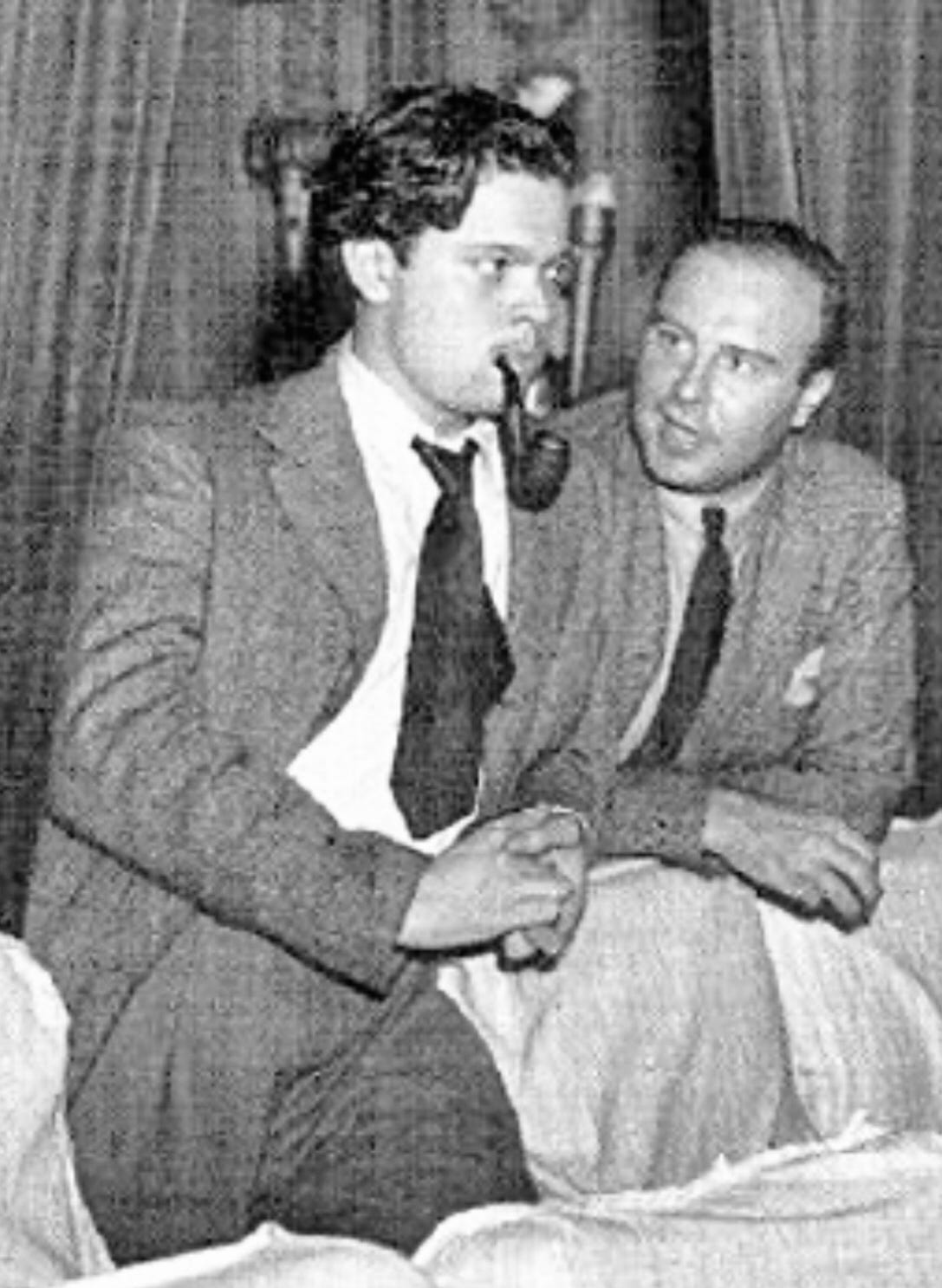
[Above: Orson Welles, 22, and John Houseman, 35, founders of the Mercury Theatre. They hired Price in 1937.]
Welles, born in Kenosha, Wisconsin, had just turned 22, and was considered to be the “boy wonder” of American theater. He and Houseman had produced a sensational version of MACBETH—with an all African-American cast—for the WPA in 1936. Welles had also headed up a modern-dress version of Shakespeare’s JULIUS CAESAR in 1937 that was also a sensation. In addition, Welles was becoming a staple on radio, having just started voicing Lamont Cranston in THE SHADOW.
Interestingly, Welles’s father, Richard Head Welles, had attended college with—and had been friendly with—Vincent Price, Sr. at the University School in Kenosha, Wisconsin. They had even done a magic act together. While there is no evidence that Orson Welles and Vincent Price, Jr. knew each as children, what we DO know is that Price later attracted the attention of the boy wonder.
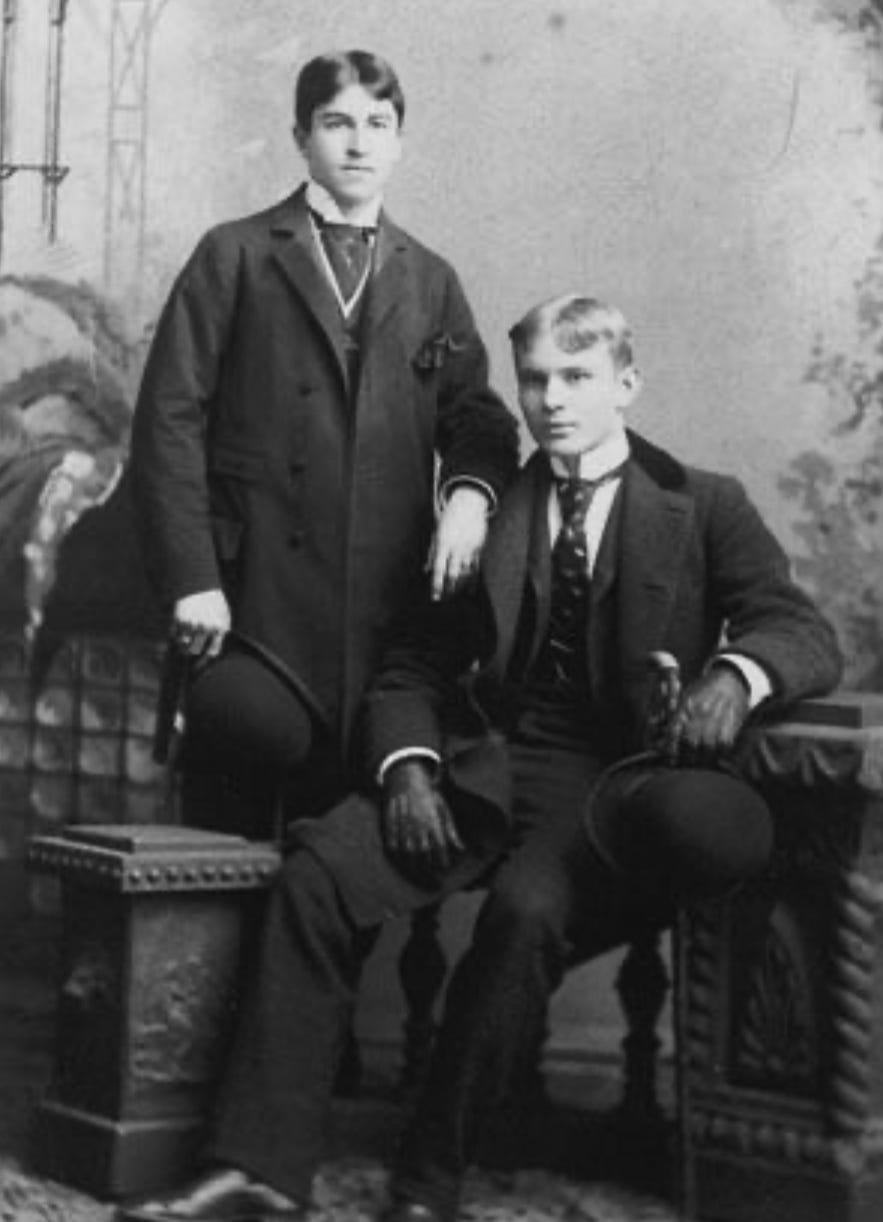
[Above: The fathers of Orson Welles (L) and Vincent Price (R) were friends in college.]
Another interesting parallel lies in the fact that Welles, too, had to lie his way into getting his first theatrical job. As a 16-year-old touring Ireland, Welles crashed the Gate Theatre, and told owners Hilton Edwards and Michael Mac Liammoir that he was a Broadway star. Edwards and Mac Liammoir saw straight through him. But Orson’s imposing presence, and—of course—his marvelous voice, led them to agree to give him a chance. And it went from there.
Vincent’s first performance for Welles and Houseman was in THE SHOEMAKER’S HOLIDAY, the debut being a surprise performance which happened on Christmas night in 1937.
“Vincent came into the Mercury as a star,“ actor Norman Lloyd recalled. “We were just scruffy individuals. Here comes this long drink of water…Gonna take all the leading parts from us, is he? That was just our attitude, but he was such a charmer that at the end of the day it was as if he was just another scruffy individual, which of course he never was. It was great chemistry and everyone had a great time with each other.“
On April 22, 1938, Edith and Vincent were married at the St. Thomas Episcopal Church at 5th Avenue and 53rd Street in New York. Welles attended the ceremony, and after the performance of THE SHOEMAKER’S HOLIDAY that night, Orson threw a party to celebrate their marriage.
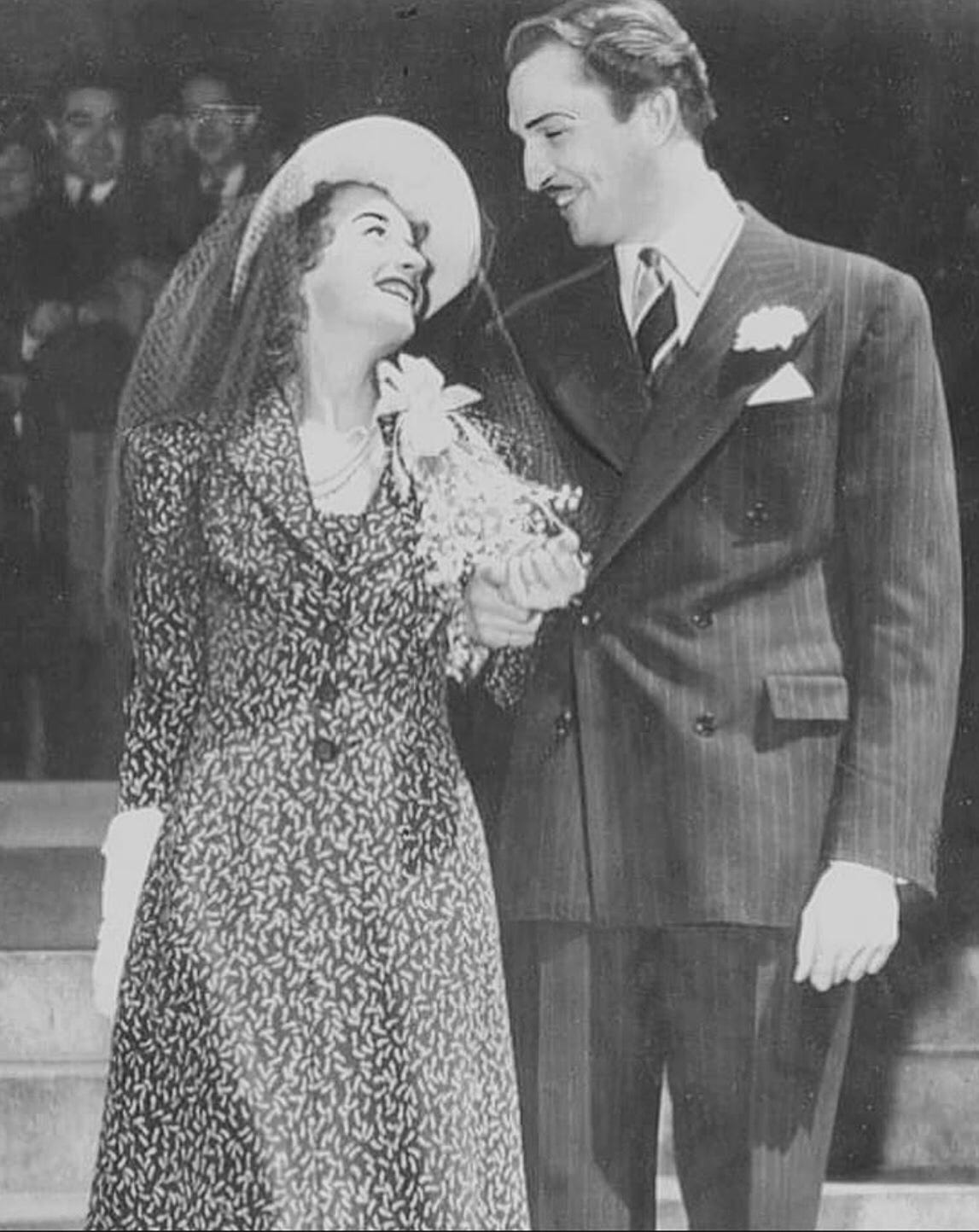
[Above: Vincent with his first wife Edith Barrett.]
Asked years later about working with Welles, Vincent’s opinions were mixed.
“He was a really brilliant director,“ Price would tell interviewer Lawrence French, “although I never thought he was a very good actor. I mean, he’s too Orson Welles. There’s absolutely no characterization at all.…He was completely undisciplined…I would have loved to have worked with him again, but everybody in the Mercury Theatre had a bit of a falling out with Orson.”
Vincent was soon cast in the Welles production of George Bernard Shaw’s HEARTBREAK HOUSE. This was another success, and landed Welles—in full makeup—on the cover of TIME magazine. Vincent’s reputation was enhanced as well.
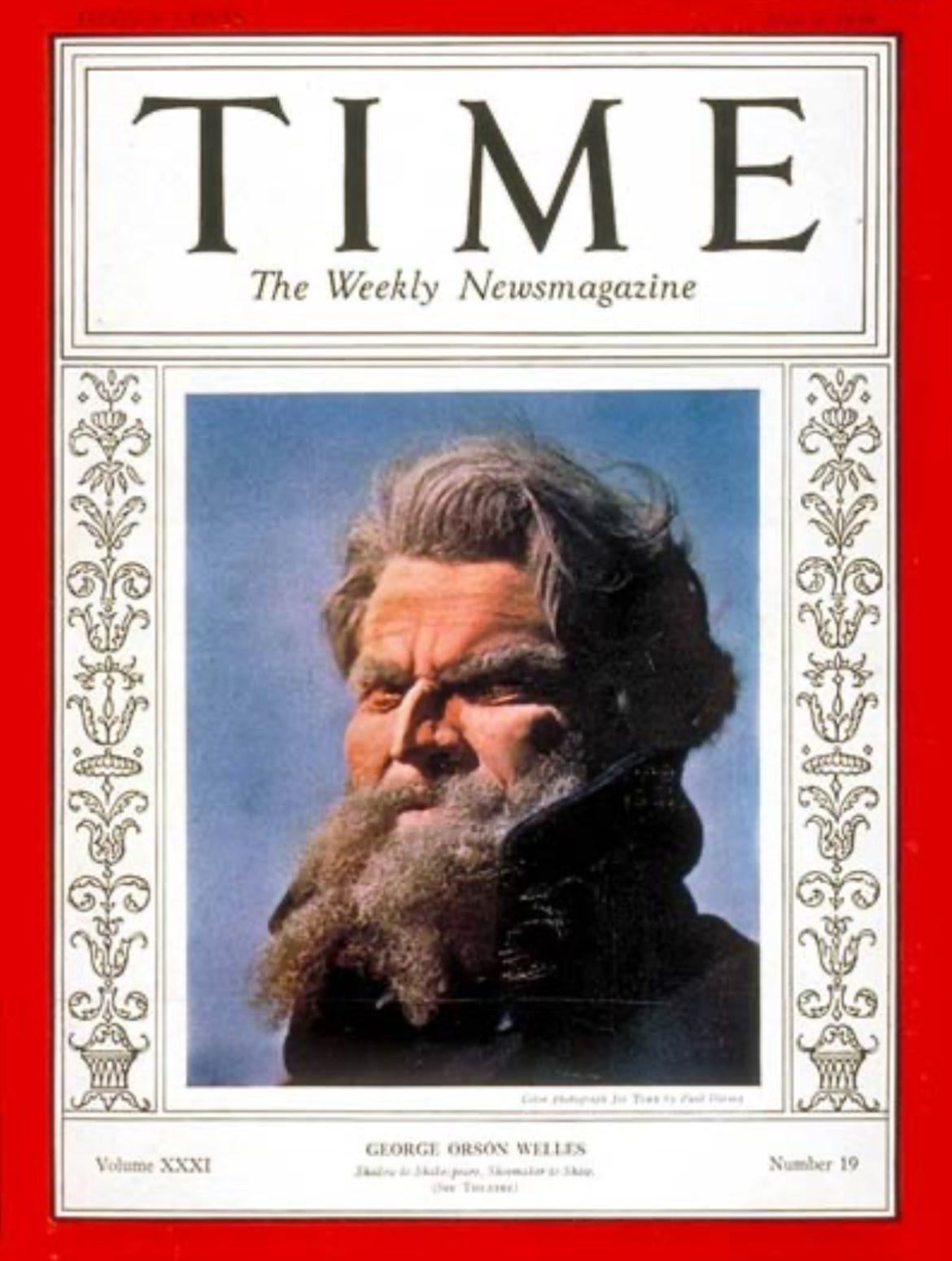
[Above: Orson Welles in full harness for HEARTBREAK HOUSE on the cover of TIME.]
But the end came near when the eclectic Welles decided that he was going to stitch together a gigantic production from various pieces of a number of Shakespearian plays, a project which he entitled FIVE KINGS. This epic was to be performed over the span of two nights. But Welles could never summon the will to head up consistent rehearsals, nor could he manage the very complicated rotating stage that he designed for the show.
And then, everything bottomed out.
“There were two plays we were supposed to do,“ Price told French. “Oscar Wilde’s THE IMPORTANCE OF BEING ERNEST, and John Webster‘s THE DUCHESS OF MALFI…Orson was going to direct both of them, and the actors had contracts to do them. Then, when we went to rehearse them, Orson never showed up. He didn’t show up for either show. He just decided he didn’t want to do them, and he didn’t bother to tell the actors.”
One by one, the Mercury contract players bailed out. Welles and Houseman—recently signed to a lucrative CBS radio contract—temporarily lost interest in the theater. Since Vincent was never officially part of the Mercury Theatre—rather, he was a hired gun—he found himself in a bit of a pickle. He decided that it was actually time to go to Hollywood, where he began his first film, SERVICE DELUXE.
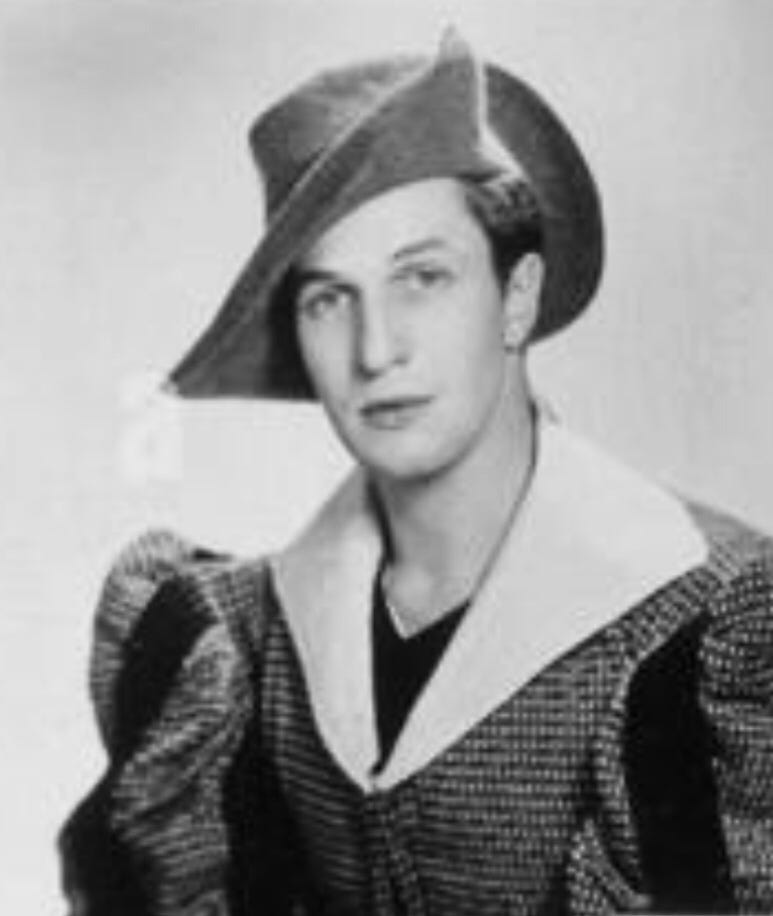
[Above: Price in his first Mercury production, THE SHOEMAKER’S HOLIDAY.]
Welles and Houseman eventually found themselves in Hollywood as well, in the wake of the sensational WAR OF THE WORLDS broadcast that frightened many on the night of October 30, 1938. And, of course, it was there that they made CITIZEN KANE. But Welles and Vincent would never work together again.
“I’m sorry I never got to know Orson Welles better,“ Price would say later. “But he became a legend before his time. He could have been one of the greatest American theatrical and cinema directors, but he had to act. Whether he directed or acted, a play was his show and finally, for that reason, and for the fact that he ignored contracts and gave no one else any credit, the Mercury fell apart.“
Welles, while not really connected to the Classic Horror genre per se, certainly danced around it from time to time. One could argue that THE WAR OF THE WORLDS was something of a horror show, since so many people were scared by it. Then too, one of the Mercury Theatre’s most famous broadcasts was Welles’s version of DRACULA. Furthermore, the opening scene of CITIZEN KANE would not be out of place in a contemporaneous Universal horror film. And his cinematic version of MACBETH—made in 1946 for Republic, but not released until 1948, thanks to production problems—could also be categorized as a classic horror film. Sadly, Welles died in 1985 of a sudden heart attack at the age of 70.
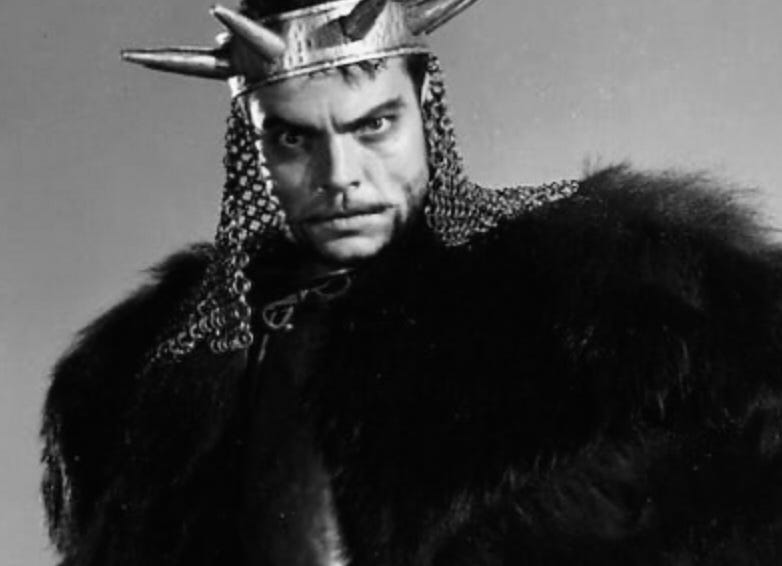
[Above: Welles in MACBETH, arguably his entrance into Classic Horror Cinema.]
SOURCES
Parish, James, Robert, and Steven Whitney. Vincent Price on masked. New York Colon-Drake publishers Inc. 1974. Print.
Beck, Calvin Thomas. Heroes of the horrors. New York Colon-MacMillan publishing Inc. 1975. Print.
“The Stage Career of Vincent Price.” Love Letters to Old Hollywood. May 31, 2018. Web.
“Vincent Price and Christopher Lee agree: Orson Welles was a genius of the cinema!“ wellesnet.com. May 28, 2008. Web.
Leaming, Barbara. ORSON WELLES. New York: Viking Press, 1985. Print.
Note: The pictures utilized herein are intended for educational purposes only. I do not own the copyrights, nor do I make any money from this website.
I get you. Not everyone is a Welles fan. I happen to like most of his work, but VP was often correct about OW’s acting. He’s not everybody’s cup of java, and Hollywood was wary of him from the get-go.
I have never been able to see what the hype is about Orson Welles. I don’t like the man nor his films. I have never seen Citizen Kane and it is most definitely not on my bucket list. However, I do love Vincent Price and his comment included in your blog:
“He was a really brilliant director,“ Price would tell interviewer Lawrence French, “although I never thought he was a very good actor. I mean, he’s too Orson Welles. There’s absolutely no characterization at all.…He was completely undisciplined…I would have loved to have worked with him again, but everybody in the Mercury Theatre had a bit of a falling out with Orson.”
Way to go, Vinnie.